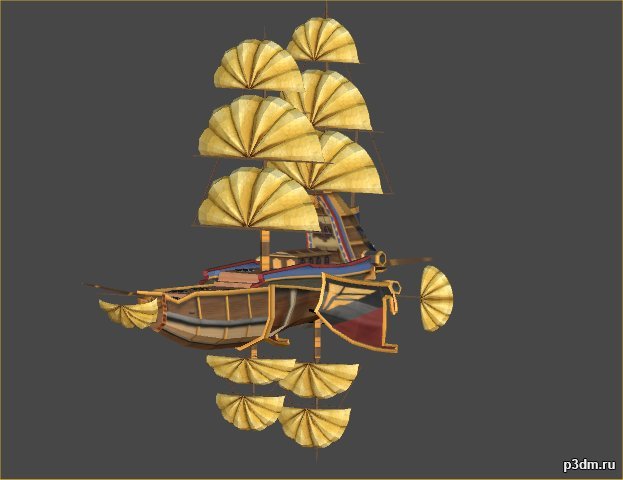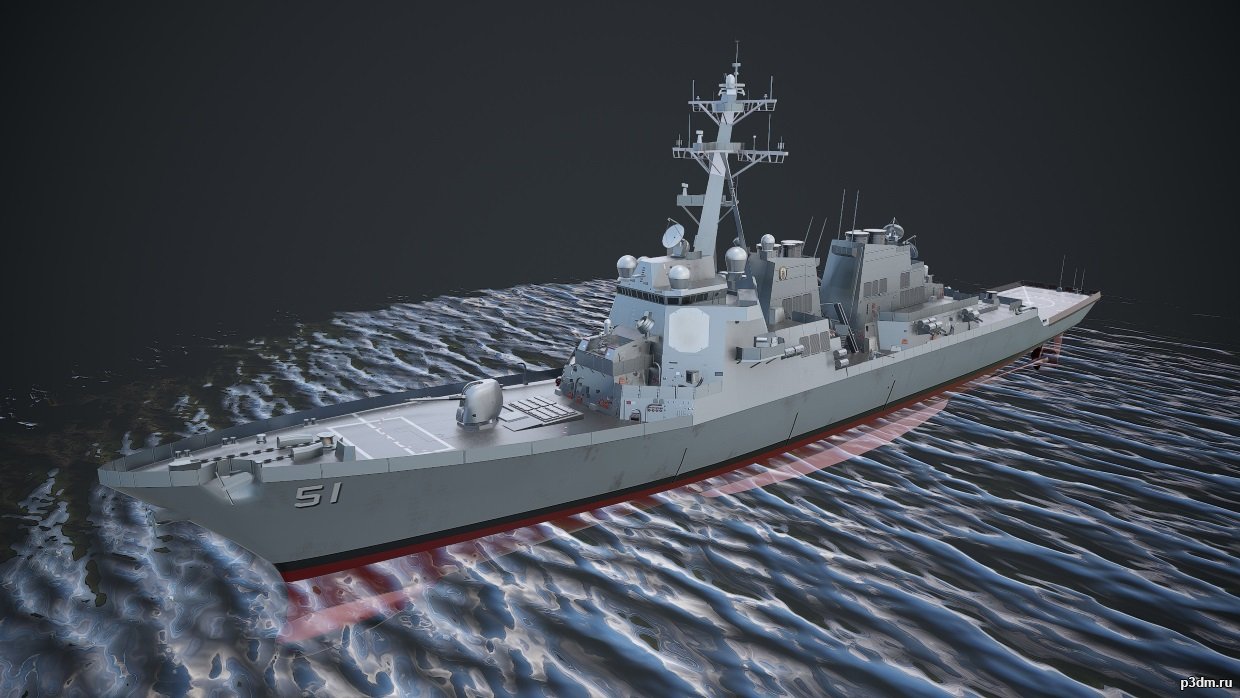
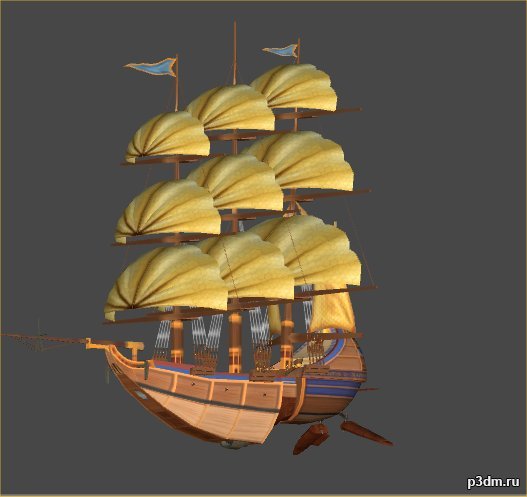
The Royal Navy Fast Scout, AKA The RLS Legacy
Tag: Navy
-
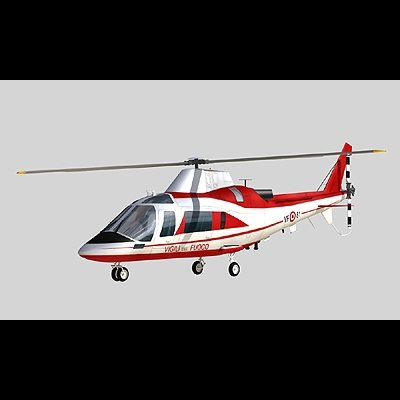
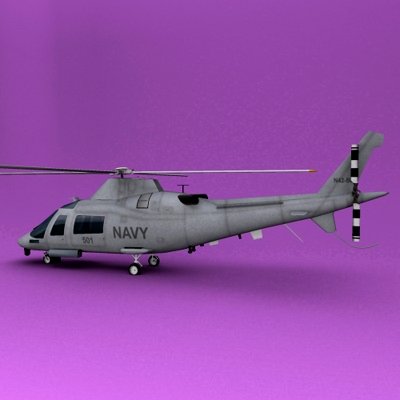
Agusta A-109 Vigili del Fuoco 3D Model
Agusta A-109.The texture is for The Vigili del Fuoco, the Fire Watchers.
-
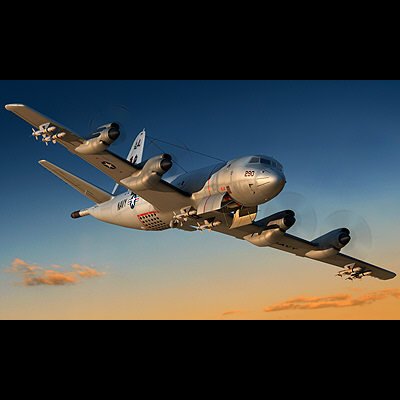
P-3C US Navy with High and Low scheme 3D Model
A detailed model of the P-3 Orion Anti-Submarine aircraft.Fully detailed bomb bay, gear bay and landing gear. The MK-46 Torpedoes, AGM-65 and AGM-84 are included.The slider control is added in 3ds Max version for front and main landing gears, the bay door and the door for the weapon bay.Two textures are added, including US Navy Low and High Visibility texture.The propeller’s rotating effect has been added to 3ds Max version. To realize it, just unhide the roter set and hide the propeller.The model is originally made in 3ds Max 9. The close-up render for other formats might need mesh smooth modifier.The render scene are not included.
-
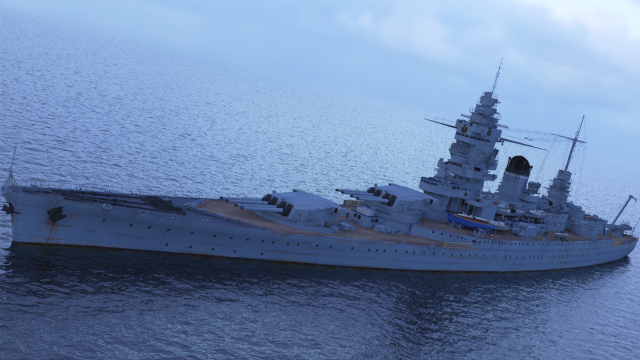
Dunkerque battleship 3D Model
The Dunkerque-class battleship was a type of warship constructed for the French Navy in the 1930s.The Dunkerques were designed to counter the German Deutschland-class pocket battleships. Their main armament was two quadruple 330 mm turrets forward, with a 225 mm (8.9 in) thick armored belt. They were smaller, with a 26,500- to 27,300-ton standard displacement and a smaller main artillery caliber, than the battleships authorized by the Washington Naval Treaty, but their speed was 7 knots higher than any of the battleships built from 1920 to 1937. When they were commissioned, only the last existing battlecruisers of the British Royal Navy and the Imperial Japanese Navy were their equals.Given their characteristics, they were alternatively classified as fast battleships, small battleships, battlecruisers, and even as “ships of the line” (Fr. navires de ligne).Two ships, Dunkerque and Strasbourg, were completed. Together they formed the 1ere Division de Ligne (“1st Division of the Line”), and saw service during the early years of the Second World War. While they never encountered the German pocket battleships they were designed to counter, they suffered the British attack of Mers-el-Kebir, and stayed under the Vichy authorities control until they were scuttled at Toulon in November 1942.Textures from 256×256 to 4096×4096 DDS/JPGDiffuse, Opacity
-
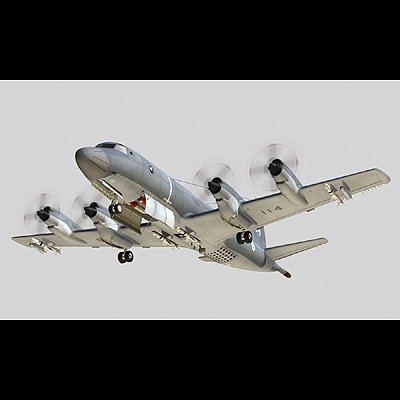
CP-140 Aurora 3D Model
A detailed model of the P-3 Orion Canada Anti-Submarine aircraft.Fully detailed bomb bay, gear bay and landing gear. The MK-46 Torpedoes, AGM-65 and AGM-84 are included.The slider control is added in 3ds Max version for front and main landing gears, the bay door and the door for the weapon bay.The texture is for Canada Air Force.The propeller’s rotating effect has been added to 3ds Max version. To realize it, just unhide the roter set and hide the propeller.The model is originally made in 3ds Max 9. The close-up render for other formats might need mesh smooth modifier.The render scene are not included.
-
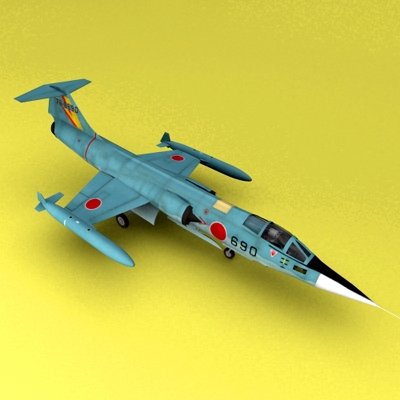
F-104 Starfighters 3D Model
Because of its physical appearance and performance, the F-104 has often been called the ‘missile with a man in it.’ The design was a product of the Korean War, and was unique in several respects. The encounters with the MiG-15 in Korea caused a strong outcry among Air Force fighter pilots for a cheap, lightweight, maneuverable, high-performance fighter to confront future Soviet fighters. The result was the F-104, a fighter that overemphasized rate of climb and brute speed. Intended as a point defense interceptor, range was sacrificed for rate of climb. Range, however, could be extended using external tanks and in-flight refueling. It used an exceptionally small wing span of only 21 feet, and provided low speed lift through air bled from the engine and vented over the wing. Designed as a supersonic superiority fighter, the F-104 was produced in two major versions. Armed with a six-barrel M-61 20mm Vulcan cannon it served as a tactical fighter and, equipped additionally with heat-seeking Sidewinder missiles, as a day-night interceptor. The USAF procured about 300 Starfighters in one- and two-seat versions. The texture is for JASDF.
-
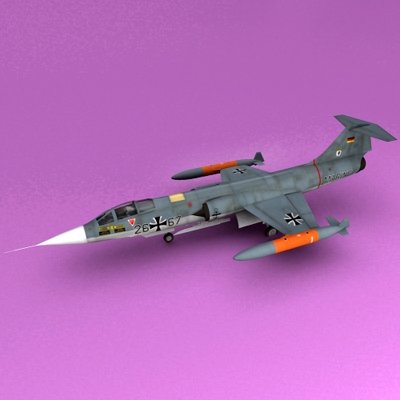
F-104 3D Model
Because of its physical appearance and performance, the F-104 has often been called the “missile with a man in it.” The design was a product of the Korean War, and was unique in several respects. The encounters with the MiG-15 in Korea caused a strong outcry among Air Force fighter pilots for a cheap, lightweight, maneuverable, high-performance fighter to confront future Soviet fighters. The result was the F-104, a fighter that overemphasized rate of climb and brute speed. Intended as a point defense interceptor, range was sacrificed for rate of climb. Range, however, could be extended using external tanks and in-flight refueling. It used an exceptionally small wing span of only 21 feet, and provided low speed lift through air bled from the engine and vented over the wing. Designed as a supersonic superiority fighter, the F-104 was produced in two major versions. Armed with a six-barrel M-61 20mm Vulcan cannon it served as a tactical fighter and, equipped additionally with heat-seeking Sidewinder missiles, as a day-night interceptor. The USAF procured about 300 Starfighters in one- and two-seat versions. The texture is for Germany Marine.
-
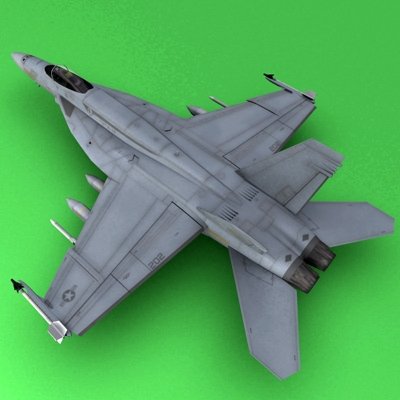
F-18E 3D Model
The combat-proven F/A-18E Super Hornet is a next generation strike fighter with all the capability, flexibility and performance necessary to modernize the air or naval aviation forces of any country. Built by the industry team of Boeing, Northrop Grumman, GE Aircraft Engines, Raytheon and more than 2,000 suppliers nationwide, the Super Hornet embodies the newest advances in multimission capability and decades of growth potential.
-

F-18E-F Super Hornet 3D Model
f-18 f/a-18 f/a-18e f/a-18f f/a-18g f18 f18e super hornet carrier fighter bomber prowler growler jammer boeing mcdonnell douglas us navy marine corps
-
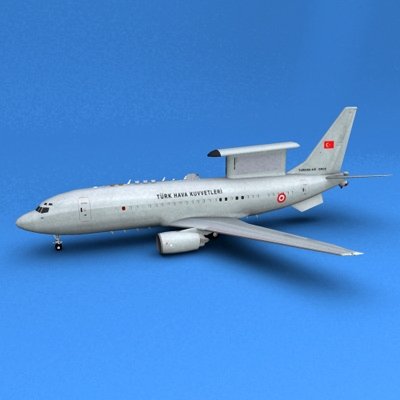
Turkey AWACS 3D Model
AWACS is the world’s standard for airborne early warning systems. It supplies tactical and air defense forces with surveillance and command and control communications. Its flexible, multimode radar, in a rotating radome mounted above the fuselage, allows AWACS to separate maritime and airborne targets from ground and sea clutter. It has a 360-degree view of an area and at operating altitudes can detect, identify and display targets more than 200 miles away. This is for Turkey.
-
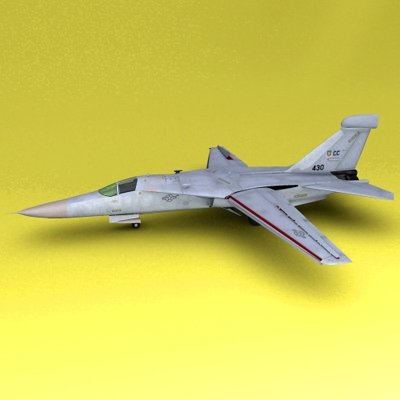
EF-111 3D Model
The EF-111A provided protection by using a jamming orbit where it stands off from threat radars to cover friendly aircraft entering and leaving the threat areas, or by using the aircraft’s high-performance capabilities to directly support attacking forces. In the direct support mission, the Raven may fly as in escort position or enter a threat area to the best jammer position. Ravens engaged in direct support often use the extensive night terrain-following capability built into the basic F-111 design.
-
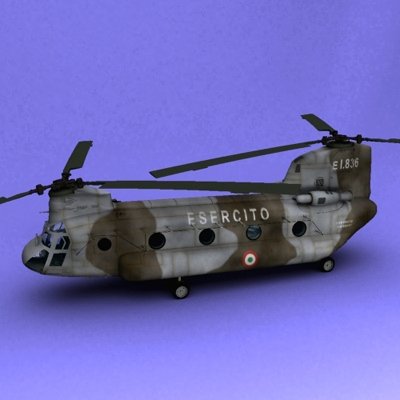
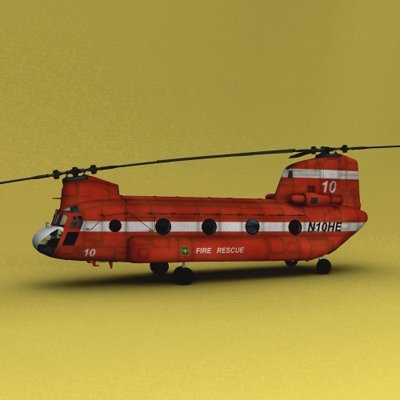
Ch-47 Italy 3D Model
The CH-47 Chinook, the workhorse of the US Army, is manufactured by the Boeing Vertol company. The Chinook has served as the prime mover for the US Army and other military forces for decades. Its principal missions include transport of troops, artillery, ammunitions, fuel, water, barrier materials, supplies and equipment on the battlefield. Other missions include medical evacuation, aircraft recovery, fire fighting, parachute drops, heavy construction, civil development, disaster relief, and search and rescue. In the US Army National Guard and among international customers, Chinooks often expend the majority of their flight hours on these latter missions. This texture is for Italy Army.
-
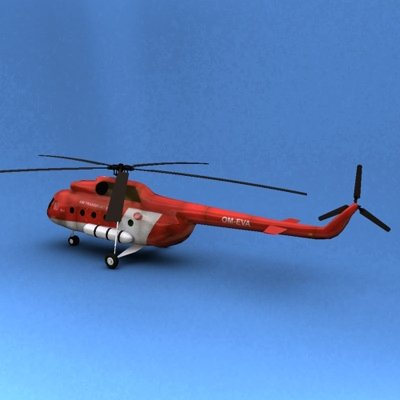
Mi8 3D Model
The MI-8 HIP is a multi-role transport helicopter capable of carring troops or supplies as well as conducting armed attackes with rockets and guns. It is often used to resupply guerrillas, insert detachments or provide close air support to attacking units. Designed as a transport helicopter, the Mi-8 proved a multi-purpose machine. The cable external suspension, equipped with the weight-measuring device, makes it possible to carry large size cargoes weighing up to three tons. If required, it became both combat, rescue and artillery observation helicopter.
-
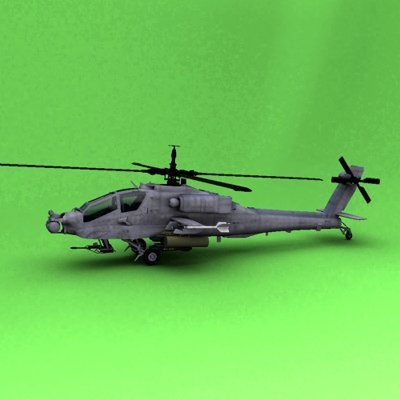
Apache 3D Model
The Apache was developed by McDonnell Douglas to meet a U.S. army requirement for a day/night all weather anti armor ground support attack aircraft with a high potential for survival in the battlefield. The first flight took place on September 30, 1975, with production deliveries to the U.S. Army starting on January 1984. Taking a major part in the Gulf War, it has also been used in Panama, Somalia and other theaters of operation. The texture is for US Army.
-
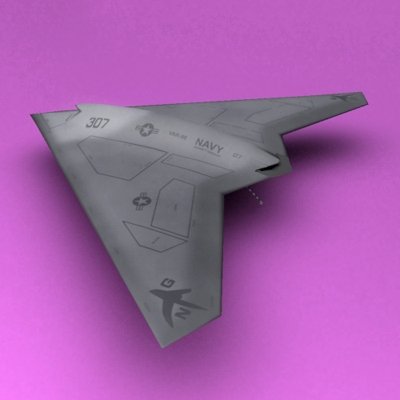
X-47 3D Model
X-47B Joint Unmanned Combat Air Systems (J-UCAS) aircraft, the world’s first unmanned surveillance attack aircraft that can operate from both land bases and aircraft carriers. Production is taking place in the St. Louis, Mo., manufacturing facility of Northrop Grumman’s teammate, GKN Aerospace. GKN is responsible for both the design and fabrication of the X-47B’s forward fuselage.The Defense Advanced Research Projects Agency (DARPA)/U.S. Air Force/U.S. Navy J-UCAS program will demonstrate the technical feasibility and operational utility of low-observable-or “stealth” -land- and sea-based unmanned surveillance attack aircraft, and provide the Air Force and Navy the option to acquire these systems early in the next decade.
-
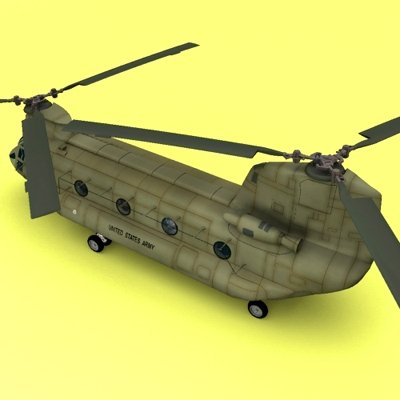
Ch-47 US Army 3D Model
The CH-47 Chinook, the workhorse of the US Army, is manufactured by the Boeing Vertol company. The Chinook has served as the prime mover for the US Army and other military forces for decades. Its principal missions include transport of troops, artillery, ammunitions, fuel, water, barrier materials, supplies and equipment on the battlefield. Other missions include medical evacuation, aircraft recovery, fire fighting, parachute drops, heavy construction, civil development, disaster relief, and search and rescue. In the US Army National Guard and among international customers, Chinooks often expend the majority of their flight hours on these latter missions.
-
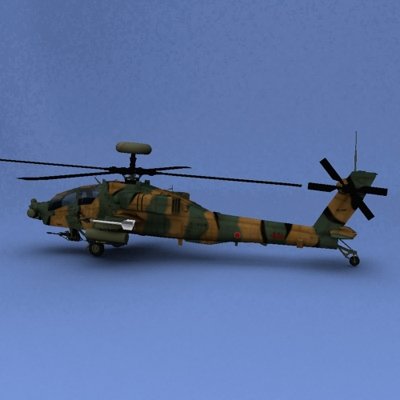
AH-64 Apache JASDFD 3D Model
AH-64DJ for JASDF(Japan Air Self-Defense Force). According to the report that Boeing authorized the Japanese company Fuji Heavy Industries (FHI) Utsunomiya NASA factory to produce AH-64DJ U.S. Army AH-64D ‘Bow Apache,’ the Japanese improved version. AH-64DJ JGSDF service will replace the AH-1S ‘Cobra’ helicopter as the main anti-Japan’s future Tanks / helicopter gunships.AH-64DJ equipped with the AIM-92 ‘Stinger’ air-to-air missiles and all millimeter-wave radar, air combat capability and survivability during wartime is better than AH-1S.
-
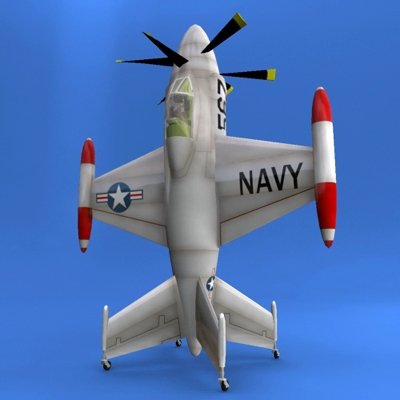
XVF-1 Salmon 3D Model
The Lockheed vertical riser, developed at the same time as Convair’s Pogo. Both machines used similar Allison YT-40 coupled engines and large diameter contra-rotating propellers. Flown by Herman ”Fish” Salmon, the design was initially tested in ¼-scale model form. Fully illustrated with photos and 3-view drawings.
-
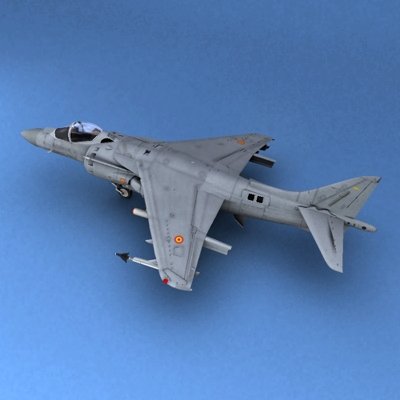
AV-8 Spanish 3D Model
The AV-8B Harrier II Plus is a multi-mission, short-takeoff vertical landing (STOVL) tactical strike aircraft. Because of its short-to-vertical takeoff and landing characteristics, it possesses basing flexibility that is unmatched by other fixed-wing aircraft. Furthermore, it supports a broad selection of air-to-air and air-to-surface weapon systems and third-generation technologies that address diverse tactical scenarios. This texture is for Spanish Air Force.
-
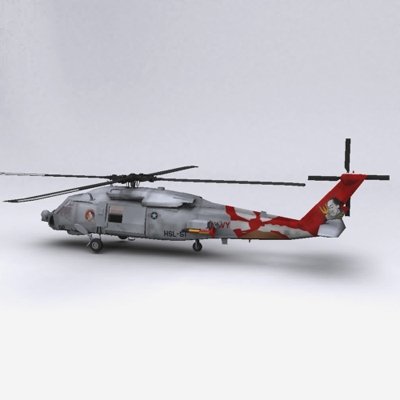
Sh-60 3D Model
The Seahawk is a twin-engine helicopter. It is used for anti-submarine warfare, search and rescue, drug interdiction, anti-ship warfare, cargo lift, and special operations. The Navy’s SH-60B Seahawk is an airborne platform based aboard cruisers, destroyers, and frigates and deploys sonobouys (sonic detectors) and torpedoes in an anti-submarine role. They also extend the range of the ship’s radar capabilities. The Navy’s SH-60F is carrier-based. Some versions, such as the Air Force’s MH-60 G Pave Hawk and the Coast Guard’s HH-60J Jayhawk, are equipped with a rescue hoist with a 250 foot (75 meter) cable that has a 600 pound (270 kg) lift capability, and a retractable in-flight refueling probe. The Army’s UH-60L Black Hawk can carry 11 soldiers or 2,600 pounds (1,170 kg) of cargo or sling load 9,000 pounds (4,050 kg) of cargo.
-
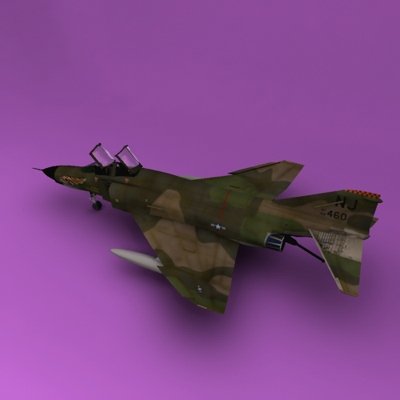
F-4 3D Model
The F-4 Phantom II was a twin-engine, all-weather, fighter-bomber. The aircraft could perform three tactical air roles — air superiority, interdiction and close air support — as it did in southeast Asia. First flown in May 1958, the Phantom II originally was developed for U.S. Navy fleet defense and entered service in 1961. The USAF evaluated it for close air support, interdiction, and counter-air operations and, in 1962, approved a USAF version. The USAF’s Phantom II, designated F-4C, made its first flight on May 27, 1963. Production deliveries began in November 1963. In its air-to-ground role the F-4 could carry twice the normal bomb load of a WW II B-17. USAF F-4s also flew reconnaissance and “Wild Weasel” anti-aircraft missile suppression missions. Phantom II production ended in 1979 after over 5,000 had been built–more than 2,600 for the USAF, about 1,200 for the Navy and Marine Corps, and the rest for friendly foreign nations, including to Israel, Iran, Greece, Spain, Turkey, South Korea, West Germany, Australia, Japan, and Great Britain. Used extensively in the Vietnam War, later versions of the aircraft were still active in the U. S. Air Force inventory well into the 1990s. F-4s are no longer in the USAF inventory but are still flown by foreign nations. This texture is for U.S Air Force.
-
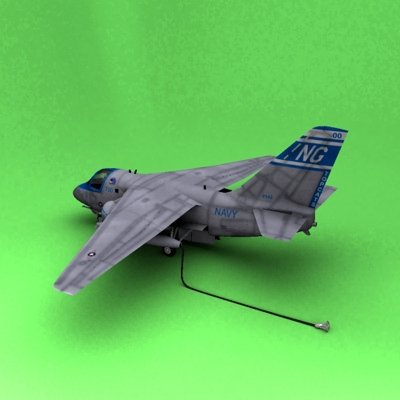
S3 VS-31 3D Model
S-3B Aircraft are tasked by the Carrier Battle Group Commanders to provide Anti-Submarine Warfare (ASW) and Anti-Surface Warfare (ASUW), surface surveillance and intelligence collection, electronic warfare, mine warfare, coordinated search and rescue, and fleet support missions, including air wing tanking. The S-3B Aircraft is manned and operated by an aircrew of four. The aircrew consists of a pilot, Copilot Tactical Coordinator (COTAC), acoustic Sensor Station Operator (SENSO), and Tactical Coordinator (TACCO). The S-3B Aircraft carries surface and subsurface search equipment with integrated target acquisition and sensor coordinating systems which can collect, process, interpret, and store ASW and ASUW sensor data. It has a direct attack capability with a variety of armament.
-
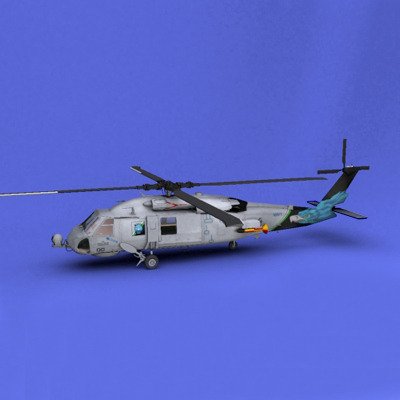
MH-60R 3D Model
The MH-60R Multi-Mission Helicopter (MMH) is the U.S. Navy’s new primary maritime-dominance helicopter, replacing the SH-60B and SH-60F aircraft. Greatly enhanced over its predecessors, the MH-60R features a glass cockpit and significant mission system improvements, which give it unmatched capability as an airborne multi-mission naval platform. The texture is for Helicopter Maritime Strike Squadron [HSM-41].
-
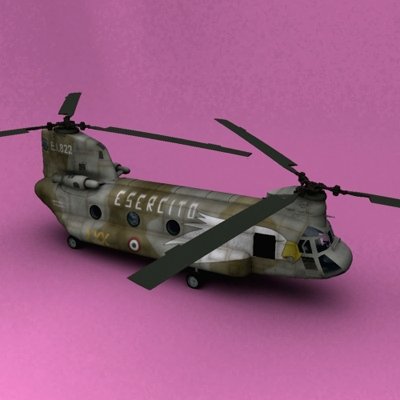
Ch-47 Italy 3D Model
The CH-47 Chinook, the workhorse of the US Army, is manufactured by the Boeing Vertol company. The Chinook has served as the prime mover for the US Army and other military forces for decades. Its principal missions include transport of troops, artillery, ammunitions, fuel, water, barrier materials, supplies and equipment on the battlefield. Other missions include medical evacuation, aircraft recovery, fire fighting, parachute drops, heavy construction, civil development, disaster relief, and search and rescue. In the US Army National Guard and among international customers, Chinooks often expend the majority of their flight hours on these latter missions. This texture is for Italy Army.
-
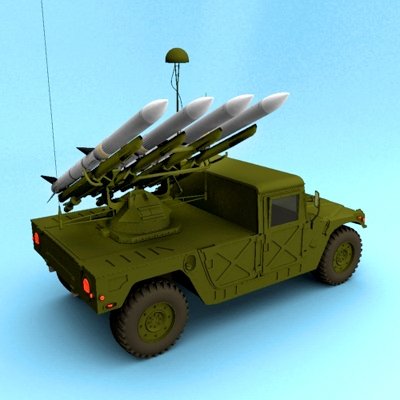
Humrqaam 3D Model
HUMRAAM is an advanced air-defense guided-missile-system launcher combining five of Raytheon’s combat-proven AMRAAM missiles on the High Mobility Multipurpose Wheeled Vehicle (HMMWV). This low-cost, high-reliability launcher provides high firepower, fire-and-forget, non-line-of-sight engagement of tactical aircraft, cruise missiles and unmanned aerial vehicles that threaten forward-maneuver forces, critical assets and vital areas, such as White House or Olympic Games.Actually, Raytheon official supplied it to 2004 Athens Olympic. Raytheon developed the HUMRAAM concept in cooperation with the US Army Aviation and Missile Command, the US Marine Corps Systems Command and Counter Air Joint Systems Project Office as a near term expeditionary air defense system.
-
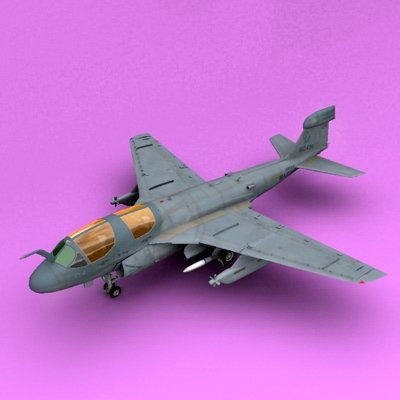
EA-6b Low Visible 3D Model
The EA-6B Prowler Improved Capability (ICAP) III airborne electronic attack weapon system. ICAP III’s advanced selective-reactive jamming ability focuses jamming power more effectively on specific radar frequencies and counters frequency-hopping radars designed to defeat older jamming systems. The system’s geolocation capability enables it to locate emitters with targetable precision and pass the information to others in the battle management network. The Navy could receive the first ICAP III EA-6B in early 2005. The model include AGM-88 HARM , auxiliary fuel tankand AN/ALQ-99 Tactical Jamming System.
-
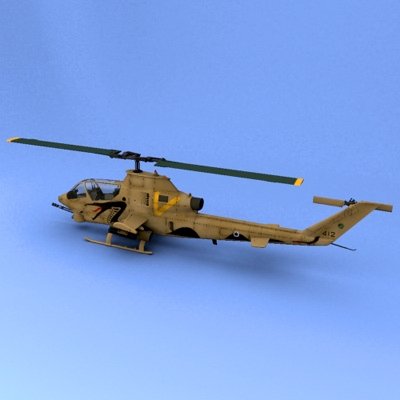
Ah-1 Israel 3D Model
The AH-1 Cobra was the world’s first dedicated (that is, specifically designed) armed attack helicopter. The need for an armed gunship to protect unarmed helicopters had quickly become apparent during the early months of the Vietnam conflict, when many helicopters were lost to ground fire. The AH-1, being fast, heavily armed, and highly maneuverable, proved itself a powerful combatant throughout the rest of the war. Its precedent-setting design has led to many other variations (including some with two engines) and a number of other armed helicopters have been developed by different manufacturers. This is for Israel Defense Forces.
-
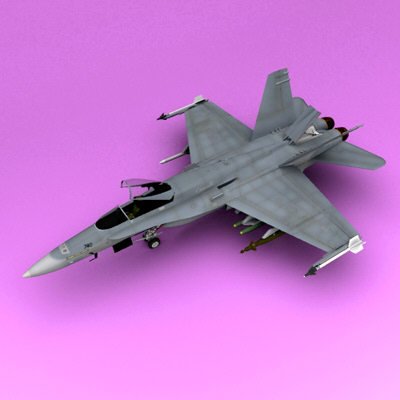
Cf-18 3D Model
The CF-18 is a multipurpose, high-performance twin-engine fighter that can equally well handle air-to-air (air defence, air superiority, combat air patrol, etc.) or ground-attack (close air support, battlefield air interdiction, etc.) roles, aided by on-board computer systems that can be quickly re-programmed to the mission at hand. (Note: The CF-18 is officially designated the “CF188” in Canadian use, although that identity is rarely employed except in the most official or technical documentation.)
-
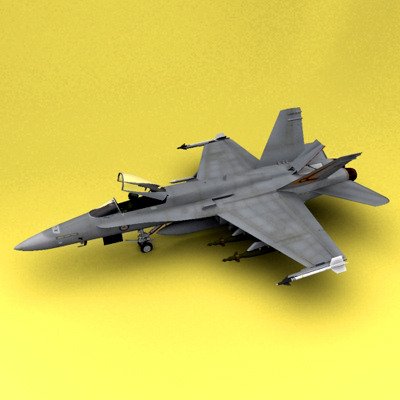
F-18 Australia Air Force 3D Model
Following a successful run of more than 400 A and B models, the US Navy began taking fleet deliveries of improved F/A-18C (single seat) and F/A-18D (dual seat) models in September 1987. These Hornets carry the Advanced Medium Range Air-to-Air Missile (AMRAAM) and the infrared imaging Maverick air-to-ground missile. Two years later, the C/D models came with improved night attack capabilities. The new components included a navigation forward looking infrared (NAVFLIR) pod, a raster head-up display, night vision goggles, special cockpit lighting compatible with the night vision devices, a digital color moving map and an independent multipurpose color display. This texture is for Royal Australia Air Force.
-
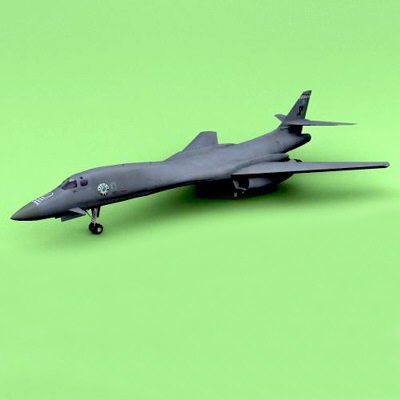
B-1B Lancer 3D Model
The B-1B is a multi-role, long-range bomber, capable of flying intercontinental missions without refueling, then penetrating present and predicted sophisticated enemy defenses. It can perform a variety of missions, including that of a conventional weapons carrier for theater operations.
-
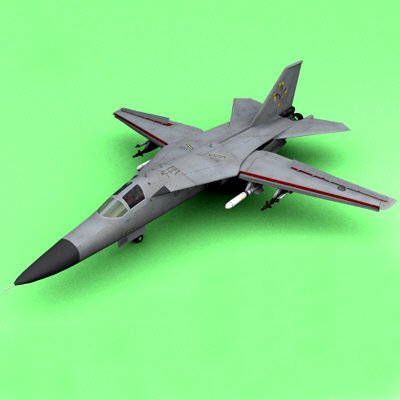
F-111 3D Model
The F-111 was a multipurpose tactical fighter bomber capable of supersonic speeds. The aircraft was one of the more controversial aircraft ever to fly, yet it achieved one of the safest operational records of any aircraft in USAF history and became a highly effective all-weather interdiction aircraft.
-
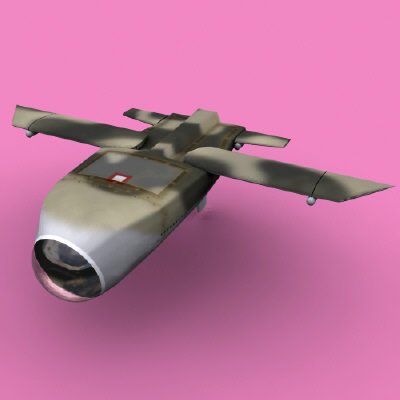
Locaas 3D Model
Lockheed Martin Missiles and Fire Control is developing the Low Cost Autonomous Attack System (LOCAAS) munition. Development is focused on miniature munition requirements for theater missile defense, suppression of enemy air defenses, interdiction missions, and armed reconnaissance. LOCAAS will carry a multi-mode explosively formed warhead. The warhead can be detonated as a long rod penetrator, an aerostable slug, or as fragments, based upon the hardness of the target. The Lockheed Martin-developed LADAR seeker can identify the target and determine the aim point and warhead mode. the model include 2 textures,one is the prototype,the other is the production version. the F/A-18E which carries the LOCAAS is not included,you can find it in the our product.
-
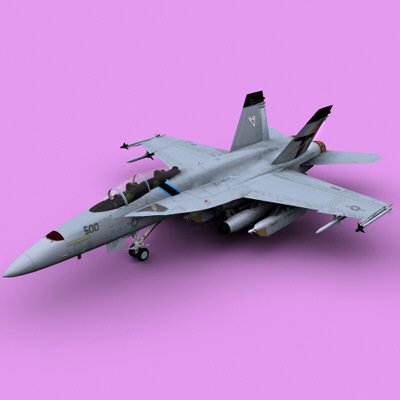
Ea18g 3D Model
The EA-18G Airborne Electronic Attack (AEA) system was selected by the U. S. Navy to replace the EA-6B Prowler aircraft. A variant of the U.S. Navy F/A-18F two-crew strike fighter, the EA-18G combines the combat-proven F/A-18F strike fighter with the proven Improved Capability III (ICAP III) AEA avionics suite. LOCAAS(Low Cost Autonomous Attack System) is also inclued as a separated file.
-
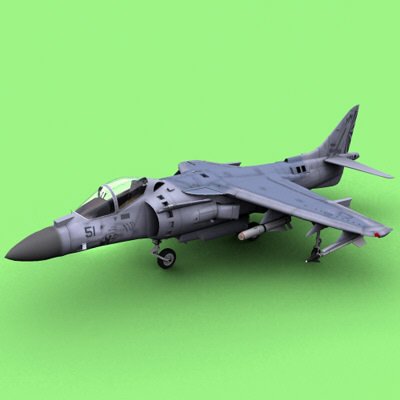
AV-8B Harrier II plus 3D Model
AV-8B Harrier II plus. Two textures are included in the model, one belongs to VMA-231 ‘Ace of Spades’, the other belongs to VMA-223 ‘Bulldogs’ which has a unique shark tatoo.
-
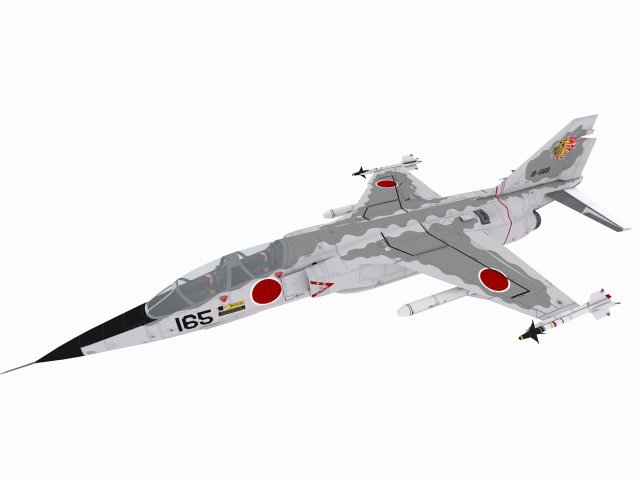
Mitsubishi T2 Sea Attack version 3D Model
The Mitsubishi T-2 sea version was a supersonic version for the Japanese Air Self Defense Force (JASDF). It was used as an sea attack as well as the original trainer mission. The T-2 used the same engine as the SEPECAT , the Turbomeca Adour, built in Japan by Ishikawajima – Harima Heavy Industries. The SEPECAT T.2 and the Mitsubishi T-2 look similar, but they’re definitely not the same aircraft. It’s a case of engineers with the same problem coming up with similar solutions.Now ina pretty ghost grey scheme armed with naval antiship missile.
-
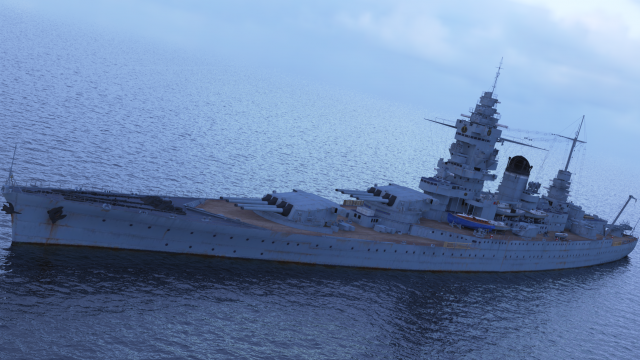
Dunkerque battleship 3D Model
The Dunkerque-class battleship was a type of warship constructed for the French Navy in the 1930s.The Dunkerques were designed to counter the German Deutschland-class pocket battleships. Their main armament was two quadruple 330 mm turrets forward, with a 225 mm (8.9 in) thick armored belt. They were smaller, with a 26,500- to 27,300-ton standard displacement and a smaller main artillery caliber, than the battleships authorized by the Washington Naval Treaty, but their speed was 7 knots higher than any of the battleships built from 1920 to 1937. When they were commissioned, only the last existing battlecruisers of the British Royal Navy and the Imperial Japanese Navy were their equals.Given their characteristics, they were alternatively classified as fast battleships, small battleships, battlecruisers, and even as “ships of the line” (Fr. navires de ligne).Two ships, Dunkerque and Strasbourg, were completed. Together they formed the 1ere Division de Ligne (“1st Division of the Line”), and saw service during the early years of the Second World War. While they never encountered the German pocket battleships they were designed to counter, they suffered the British attack of Mers-el-Kebir, and stayed under the Vichy authorities control until they were scuttled at Toulon in November 1942.Textures from 256×256 to 4096×4096 DDS/JPGDiffuse, Opacity
-
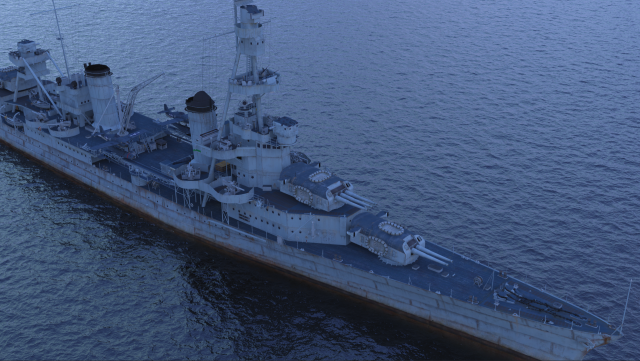
USS Pensacola CA-24 with F4F 3D Model
USS Pensacola (CL/CA-24) was a cruiser of the United States Navy that was in service from 1929 to 1945. She was the lead ship of the Pensacola class, which the navy classified from 1931 as heavy cruisers. The third Navy ship to be named after the city of Pensacola, Florida, she was nicknamed the “Grey Ghost” by Tokyo Rose. She received 13 battle stars for her service.She was laid down by the New York Navy Yard on 27 October 1926, launched on 25 April 1929, sponsored by Mrs. Joseph L. Seligman, and commissioned on 6 February 1930, Captain Alfred G. Howe in command.Textures: from 256×256 to 4096x4096Diffuse, Opacity
-
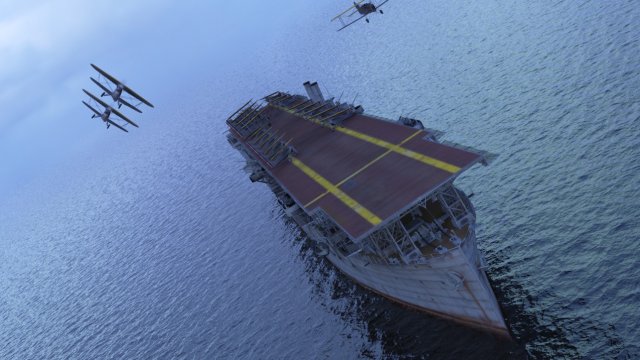
USS Langley CV-1 3D Model
Aircraft carrier USS Langley with Aeromarine 39 & Vought VE-7USS Langley (CV-1/AV-3) was the United States Navy’s first aircraft carrier, converted in 1920 from the collier USS Jupiter (AC-3), and also the US Navy’s first turbo-electric-powered ship. Conversion of another collier was planned but canceled when the Washington Naval Treaty required the cancellation of the partially built Lexington-class battlecruisers Lexington and Saratoga, freeing up their hulls for conversion to the aircraft carriers Lexington and Saratoga. Langley was named after Samuel Pierpont Langley, an American aviation pioneer. Following another conversion, to a seaplane tender, Langley fought in World War II. On 27 February 1942, she was attacked by nine twin-engine Japanese bombers of the Japanese 21st and 23rd Naval Air Flotillas and so badly damaged that she had to be scuttled by her escorts.Textures: from 256×256 to 4096x4096Diffuse, Opacity.
-
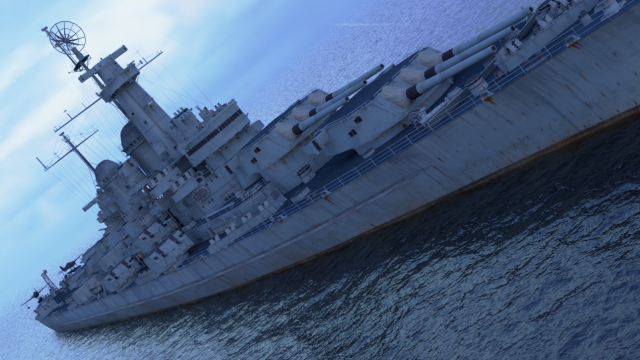
USS Montana BB-67 with F4F 3D Model
Montana was planned to be the lead ship of the class. She was the third ship to be named in honor of the 41st state, and was assigned to the Philadelphia Navy Yard. Both the earlier battleship, BB-51, and BB-67 were canceled, so Montana is the only one of the (48 at the time) US states never to have had a battleship with a “BB” hull classification completed in its honor.The Montana-class battleships of the United States Navy were planned as successors to the Iowa class, being slower but larger, better armored, and having superior firepower. Five were approved for construction during World War II, but changes in wartime building priorities resulted in their cancellation in favor of the Essex-class aircraft carrier and Iowa class before any Montana-class keels were laidTextures: from 256×256 to 4096x4096Diffuse, Opacity.
-
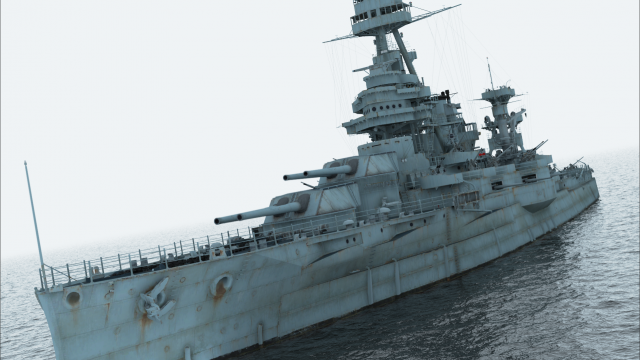
USS New York BB-34 3D Model
SS New York (BB-34) was a United States Navy battleship, the lead ship of her class. Named for New York State, she was designed as the first ship to carry the 14-inch (356 mm)/45-caliber gun.Entering service in 1914, she was part of the U.S. Navy force which was sent to reinforce the British Grand Fleet in the North Sea near the end of World War I. During that time, she was involved in at least two incidents with German U-boats, and is believed to have been the only US ship to have sunk one in the war, during an accidental collision in October 1918. Following the war, she was sent on a litany of training exercises and cruises in both the Atlantic and the Pacific, and saw several overhauls to increase her armament, aircraft handling and armor.Textures: from 256×256 to 4096x4096Diffuse, Opacity.
-
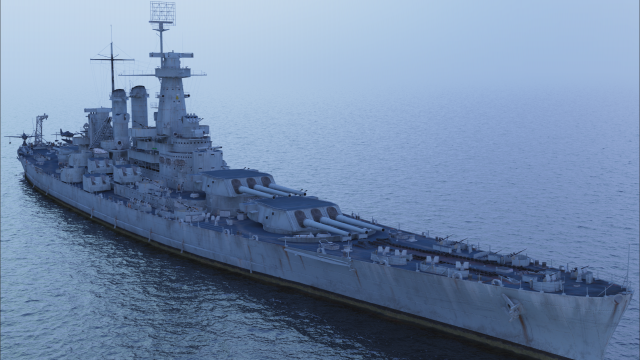
USS North Carolina BB-55 with F4F 3D Model
USS North Carolina (BB-55) is the lead ship of North Carolina-class battleship and the fourth warship in the U.S. Navy to be named for the State of North Carolina. She was the first newly constructed American battleship to enter service during World War II, and took part in every major naval offensive in the Pacific Theater of Operations; her 15 battle stars made her the most decorated American battleship of World War II. She is now a museum ship and memorial kept at the seaport of Wilmington, North Carolina.Textures: from 256×256 to 4096x4096Diffuse, Opacity
-
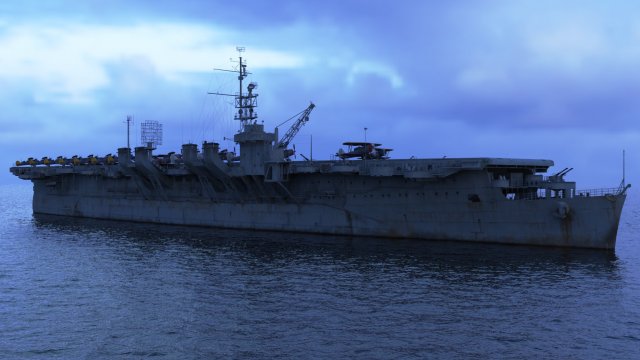
USS Independence CVL-22 3D Model
3D model USS Independence with aircraft F-4B & SBU-1. USS Independence (CVL-22) was a United States Navy light aircraft carrier, lead ship of her class and served during the Second World War.Converted from the hull of a cruiser, she was built by the New York Shipbuilding Corporation and commissioned in January 1943. She took part in the attacks on Rabaul and Tarawa before being torpedoed by Japanese aircraft, necessitating repairs in San Francisco from January to July 1944.Textures: from 256×256 to 4096x4096Diffuse, Opacity.
-
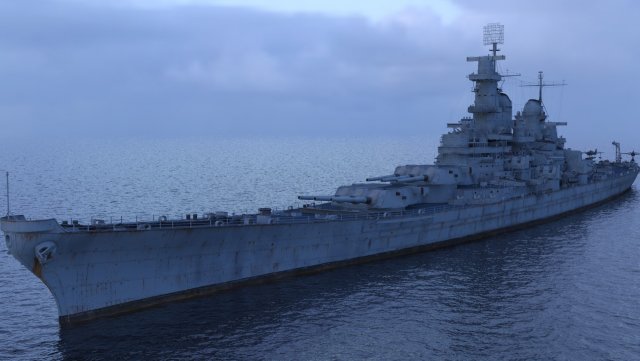
USS Iowa BB-61 with F4F 3D Model
USS Iowa (BB-61) is the lead ship of her class of battleship and the fourth in the United States Navy to be named after the state of Iowa. Owing to the cancellation of the Montana-class battleships, Iowa is the last lead ship of any class of United States battleships and was the only ship of her class to have served in the Atlantic Ocean during World War II3d model of the ship of the 1943 model.Textures: from 256×256 to 4096x4096Diffuse, Opacity.
-
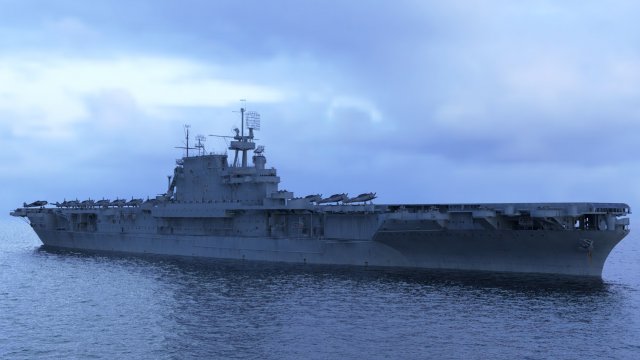
USS Enterprise CV-6 3D Model
USS Enterprise (CV-6), was the seventh U.S. Navy vessel to bear the name. Colloquially called “the Big E”, she was the sixth aircraft carrier of the United States Navy. A Yorktown-class carrier, she was launched in 1936 and was one of only three American carriers commissioned before World War II to survive the war (the others being Saratoga and Ranger). She participated in more major actions of the war against Japan than any other United States ship. These actions included the Attack on Pearl Harbor (18 dive bombers of VS-6 were over the harbor, 6 were shot down with a loss of eleven men, making her the only American Aircraft carrier with men at Pearl Harbor during the Attack and the first to receive casualties during the Pacific War), the Battle of Midway, the Battle of the Eastern Solomons, the Battle of the Santa Cruz Islands, various other air-sea engagements during the Guadalcanal Campaign, the Battle of the Philippine Sea, and the Battle of Leyte Gulf. Enterprise earned 20 battle stars, the most for any U.S. warship in World War II, and was the most decorated U.S. ship of World War II, She is also the first American ship to sink an enemy vessel during the Pacific War, the sole surviving pilot of the six planes shot down over Pearl Harbor sank Japanese submarine I-70 on 10 December 1941. On three occasions during the Pacific War, the Japanese announced that she had been sunk in battle, resulting in her being named “The Grey Ghost”.Units scael: meters.Texture: from 256 to 4096x4096Diffuse, Opacity.
-
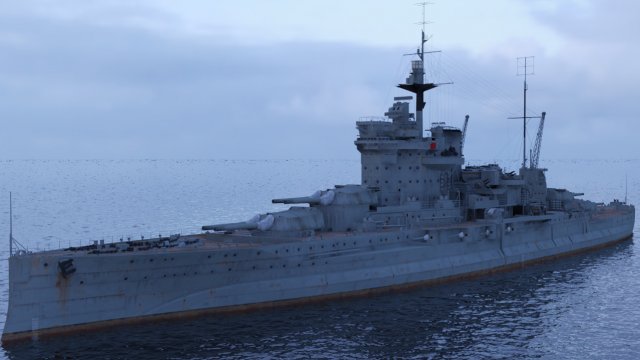
HMS Warspite with Walrus 3D Model
HMS Warspite was a Queen Elizabeth-class battleship built for the Royal Navy during the early 1910s. Her thirty-year career covered both world wars and took her across the Atlantic, Indian, Arctic and Pacific Oceans. She participated in the Battle of Jutland during the First World War as part of the Grand Fleet. Other than that battle, and the inconclusive Action of 19 August, her service during the war generally consisted of routine patrols and training in the North Sea.During the Second World War, she was involved in several major engagements, including battles in the North Sea and Mediterranean, earning her the most battle honours ever awarded to an individual ship in the Royal Navy. For this and other reasons Warspite gained the nickname the “Grand Old Lady” after a comment made by Admiral Sir Andrew Cunningham in 1943 while she was his flagship.Textures: from 256×256 to 4096x4096Diffuse, Opacity.
-
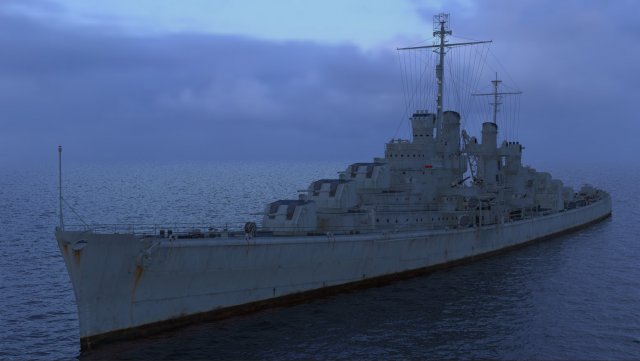
USS Atlanta CL-51 3D Model
USS Atlanta (CL-51) of the United States Navy was the lead ship of the Atlanta-class of 8 light cruisers. She was the third Navy ship named after the city of Atlanta, Georgia. Designed to provide anti-aircraft protection for US naval task groups, Atlanta served in this capacity in the naval battles Midway and the Eastern Solomons. Atlanta was heavily damaged by Japanese and friendly gunfire in a night surface action on 13 November 1942 during the Naval Battle of Guadalcanal. The cruiser was sunk on her captain’s orders in the afternoon of the same day.Textures from 256×256 to 4096x4096Diffuse, Opacity
-
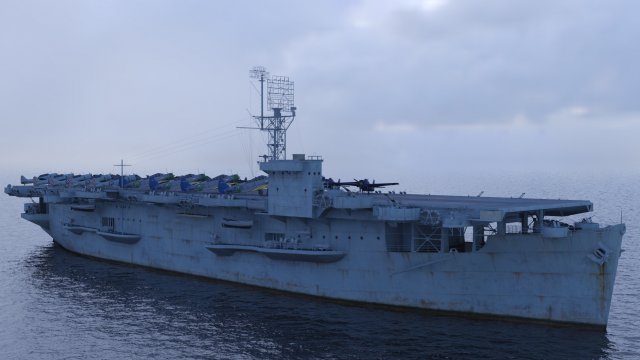
USS Bogue CVE-9 3D Model
USS Bogue (CVE-9) was the lead ship in the Bogue class of escort carriers in the United States Navy during World War II. She was originally classified AVG-9, but was changed to ACV-9, 20 August 1942; CVE-9, 15 July 1943; and CVHP-9, 12 June 1955. Aircraft operating from Bogue sank eleven German and two Japanese submarines, making her the most successful anti-submarine carrier in World War II.Aircraft carried:F6F-5N HellcatTBD-1 DevastatorTBM-3 Avenger
-
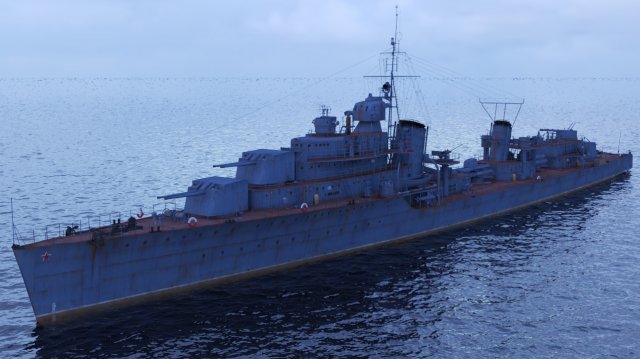
Somers-class destroyer project 48 Kiev 3D Model
Leaders of destroyers of project 48, also known as leaders of destroyers of the type “Kiev” (by the name of the main ship) – the type of leaders of destroyers, built in 1939-1941 for the Soviet Navy. In total, under the project 48 for the “Great Fleet” of the USSR, twenty leaders of destroyers were to be built at Soviet shipyards. According to the documents, by the fall of 1940 eight leaders were laid. The construction of three of them, as well as the construction of three more ships, was stopped in October 1940 in favor of the construction of the leaders of the project 47 with the universal artillery of the main caliber. Two more leaders, planned to be bookmarked at the shipyard No. 402 in Molotovsk, were never laid. In 1944-1950, a corrected 48-K project was designed at TsKB-17 and at the design bureau of plant No. 444, according to which the corps of leaders “Kiev” and “Yerevan” were to be completed, but in 1950 the leadership of the shipbuilding industry was a decision was made to abandon the completion of these two ships. Both unfinished ships were converted into target ships and flooded at various times during testing of anti-ship missiles.Textures: from 256×256 to 4096x4096Diffuse, Opacity.
-
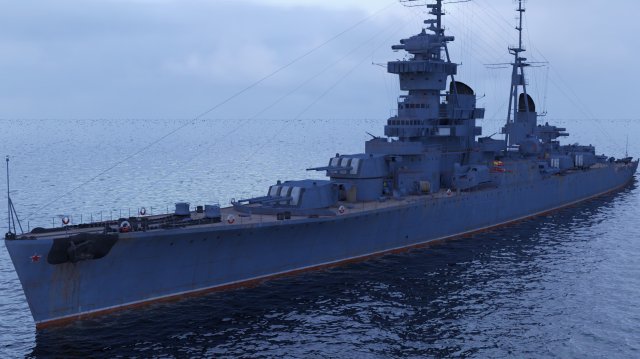
Soviet cruiser Mikhail Kutuzov 3D Model
Mikhail Kutuzov (Russian: Михаил Кутузов) was a light cruiser project no. 68-bis (designated the Sverdlov class by NATO) of the Soviet and later the Russian Navy’s Black Sea Fleet.She was laid down at the Black Sea Shipyard in Nikolayev on 23 February 1951 and commissioned on 30 February 1954. Mikhail Kutuzov joined the Black Sea Fleet after commissioning and sea trials, on 31 January 1955.On 28 July 2002, Mikhail Kutuzov was opened to the public as a museum ship in Novorossiysk. On 1 October 2012, she was made a branch of the Central Naval Museum.Textures: from 256×256 to 4096x4096Diffuse, Opacity.
-
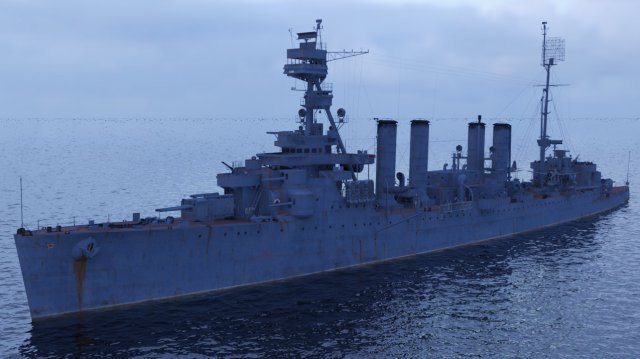
Murmansk light cruiser with OS2U 3D Model
USS Milwaukee (CL-5) was an Omaha-class light cruiser built for the United States Navy during the 1920s. The ship spent most of her early career assigned to the Asiatic and Battle Fleets. In 1941 she was assigned to the Neutrality Patrol until she was refitted in New York in late 1941. She escorted a troop convoy to the Pacific in early 1942 before returning to the South Atlantic where she patrolled for German commerce raiders and blockade runners. In November, she intercepted one of the latter, but it scuttled itself before it could be captured. In 1944 she was temporarily transferred to the Soviet Navy and commissioned as Murmansk. The ship was returned by the Soviets in 1949 and sold for scrap in December.Textures: from 256×256 to 4096x4096Diffuse, Opacity.
-
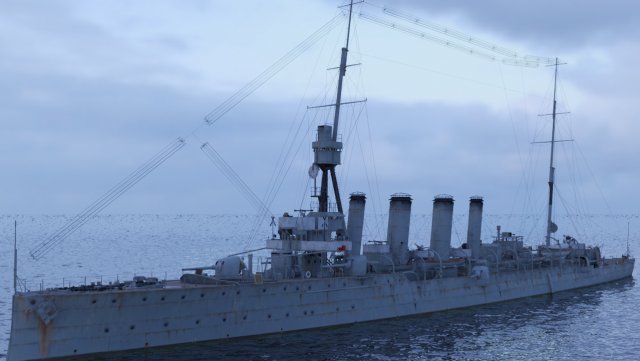
HMS Weymouth Town-class light cruiser 3D Model
HMS Weymouth was a Town-class light cruiser built for the Royal Navy during the 1910s. She was the name ship of the Weymouth sub-class of the Town class. The ship survived the First World War and was sold for scrap in 1928The ship was laid down on 19 January 1910 by Armstrong Whitworth at their Elswick shipyard and launched on 18 November. Upon completion in October 1911, Weymouth was assigned to the 3rd Battle Squadron of the Atlantic Fleet and was transferred to the 2nd Light Cruiser Squadron in the Mediterranean in June 1913. In August 1914, Weymouth was detached to sail into the Indian Ocean to hunt for the German light cruiser SMS Emden, which was raiding Allied shipping in the area. In February 1915, she was operating off the East African coast as part of operations against another commerce raider, SMS Konigsberg, eventually trapping her in the Rufiji River until she could be sunk.Textures: from 256×256 to 4096x4096Diffuse, Specular, Opacity.
-
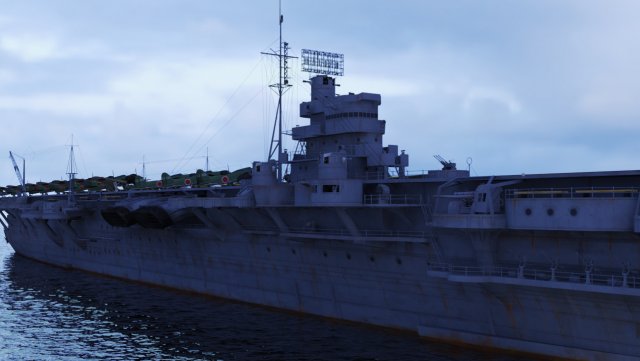
Japanese aircraft carrier Zuikaku with D3A1 A7M2 B5N2 3D Model
Zuikaku (“Auspicious Crane”) was a Shokaku-class aircraft carrier of the Imperial Japanese Navy. Her complement of aircraft took part in the attack on Pearl Harbor that formally brought the United States into the Pacific War, and she fought in several of the most important naval battles of the war, before being sunk during the Battle of Leyte Gulf.One of six carriers to participate in the Pearl Harbor attack, Zuikaku was the last of the six to be sunk in the war (four in the Battle of Midway and Shokaku in the Battle of the Philippine Sea).Textures from 256×256 to 4096x4096Diffuse, Opacity.
-
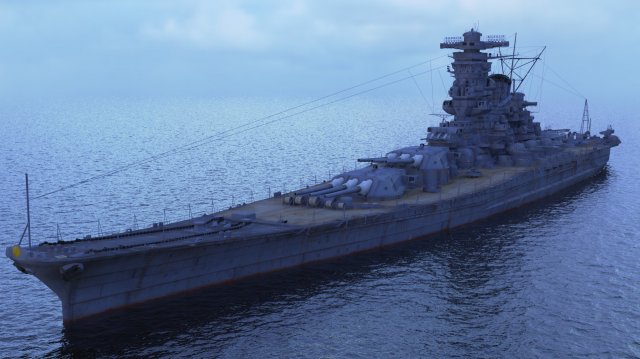
Japanese battleship Yamato 3D Model
Yamato was the lead ship of the Yamato class of Imperial Japanese Navy World War II battleships. She and her sister ship, Musashi, were the heaviest battleships ever constructed, displacing 72,800 tonnes at full load and armed with nine 46 cm 45 Caliber Type 94 main guns, which were the largest guns ever mounted on a warship. Neither ship survived the war.Units scale: meters.Textures: from 256×256 to 4096x4096Diffuse, Opacity.
-
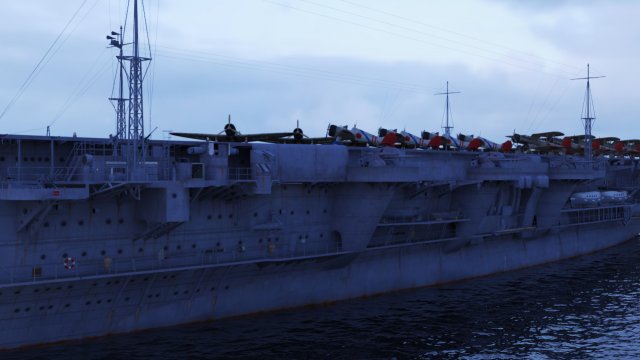
Japanese aircraft carrier Ryujo with A5M2 D3A1 B3N 3D Model
Ryujo (“Prancing Dragon”) was a light aircraft carrier built for the Imperial Japanese Navy (IJN) during the early 1930s. Small and lightly built in an attempt to exploit a loophole in the Washington Naval Treaty of 1922, she proved to be top-heavy and only marginally stable and was back in the shipyard for modifications to address those issues within a year of completion. With her stability improved, Ryujo returned to service and was employed in operations during the Second Sino-Japanese War. During World War II, she provided air support for operations in the Philippines, Malaya, and the Dutch East Indies, where her aircraft participated in the Second Battle of the Java Sea. During the Indian Ocean raid in April 1942, the carrier attacked British merchant shipping with both her guns and her aircraft. Ryujo next participated in the Battle of the Aleutian Islands in June. She was sunk by American carrier aircraft at the Battle of the Eastern Solomons on 24 August 1942.Textures from 256×256 to 4096x4096Diffuse, Opacity.
-
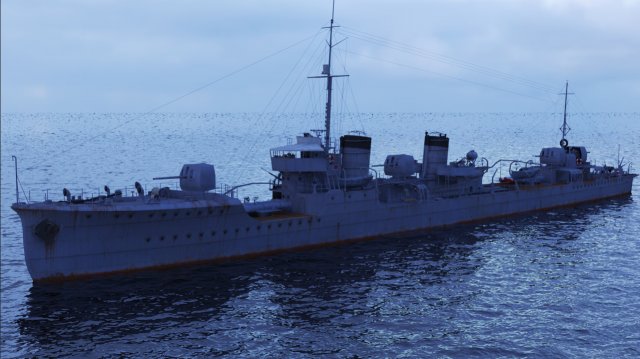
Japanese Mutsuki-class destroyer 3D Model
The Japanese destroyer Mutsuki (”January”) was the name ship of her class of twelve destroyers built for the Imperial Japanese Navy (IJN) during the 1920s. During the Pacific War, she participated in the Battle of Wake Island in December 1941 and the occupations of New Guinea and the Solomon Islands in early 1942. Mutsuki was one of the escorts for the invasion force during the Battle of the Coral Sea in May and then participated in the Guadalcanal Campaign later that year. The ship was sunk by American bombers during the Battle of the Eastern Solomons in August.Textures from 256×256 to 4096x4096Diffuse, Opacity.
-
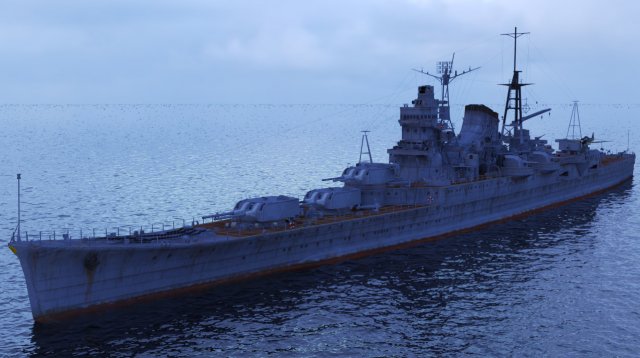
Japanese cruiser Mogami 3D Model
Mogami was the lead ship in the four-vessel Mogami class of heavy cruisers in the Imperial Japanese Navy. She was named after the Mogami River in Tohoku region of Japan. The Mogami-class ships were constructed as “light cruisers” (per the Washington Naval Treaty) with five triple 6.1-inch dual purpose guns. They were exceptionally large for light cruisers, and the barbettes for the main battery were designed for quick refitting with twin 8-inch guns. In 1937 all four ships were “converted” to heavy cruisers in this fashion. Mogami served in numerous combat engagements in World War II, until she was sunk at the Battle of Leyte Gulf in October 1944.Textures from 256×256 to 4096x4096Diffuse, Opacity.
-
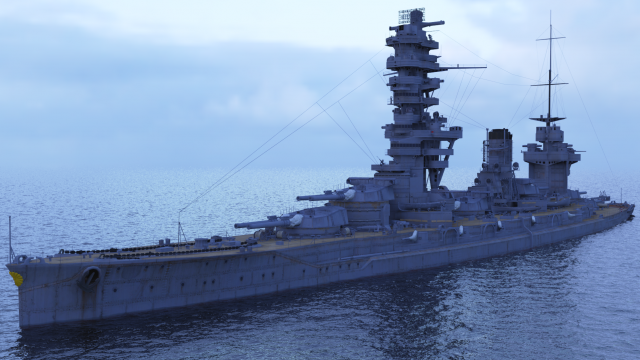
Battleship Fuso 3D Model
Fuso was the lead ship of the two Fuso-class dreadnought battleships built for the Imperial Japanese Navy. Launched in 1914 and commissioned in 1915, she initially patrolled off the coast of China, playing no part in World War I. In 1923, she assisted survivors of the Great Kanto earthquake.Fuso was modernized in 1930–1935 and again in 1937–1941, with improvements to her armor and propulsion machinery and a rebuilt superstructure in the pagoda mast style. With only 14-inch (356 mm) guns, she was outclassed by other Japanese battleships at the beginning of World War II, and played auxiliary roles for most of the war.Fuso was part of Vice-Admiral Shoji Nishimura’s Southern Force at the Battle of Leyte Gulf. She was sunk in the early hours of 25 October 1944 by torpedoes and naval gunfire during the Battle of Surigao Strait. Some reports claimed that Fuso broke in half, and that both halves remained afloat and burning for an hour, but according to survivors’ accounts, the ship sank after 40 minutes of flooding. Of the few dozen crewmen who escaped, only 10 survived to return to Japan.Textures from 256×256 to 4096×4096 DDSDiffuse, Opacity
-
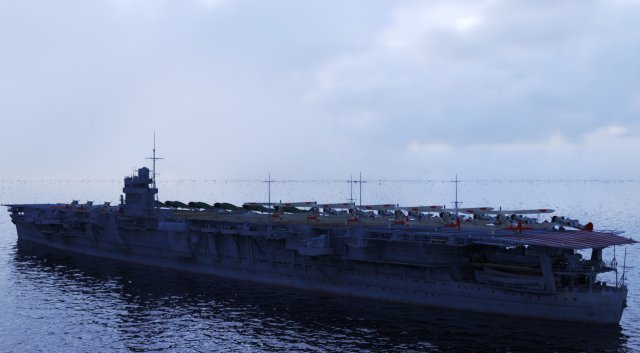
Japanese aircraft carrier Hiryu with A5M2 D3A2 3D Model
Hiryu (“Flying Dragon”) was an aircraft carrier built for the Imperial Japanese Navy (IJN) during the 1930s. The only ship of her class, she was built to a modified Soryu design.[Note 1] Her aircraft supported the Japanese invasion of French Indochina in mid-1940. During the first month of the Pacific War, she took part in the attack on Pearl Harbor and the Battle of Wake Island. The ship supported the conquest of the Dutch East Indies in January 1942. The following month, her aircraft bombed Darwin, Australia, and continued to assist in the Dutch East Indies campaign. In April, Hiryu’s aircraft helped sink two British heavy cruisers and several merchant ships during the Indian Ocean raid.After a brief refit, Hiryu and three other fleet carriers of the First Air Fleet (Kido Butai) participated in the Battle of Midway in June 1942. After bombarding American forces on the atoll, the carriers were attacked by aircraft from Midway and the carriers USS Enterprise, Hornet, and Yorktown. Dive bombers from Yorktown and Enterprise crippled Hiryu and set her afire. She was scuttled the following day after it became clear that she could not be salvaged. The loss of Hiryu and three other IJN carriers at Midway was a crucial strategic defeat for Japan and contributed significantly to the Allies’ ultimate victory in the Pacific.Textures from 256×256 to 4096x4096Diffuse, Opacity.
-
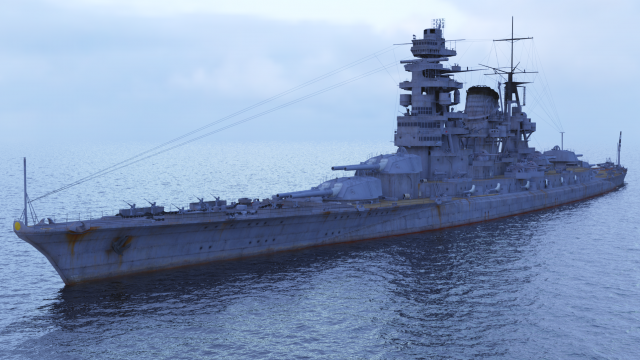
Amagi-class battlecruiser 3D Model
The Amagi class was a series of four battlecruisers planned for the Imperial Japanese Navy as part of the Eight-eight fleet. The ships were to be named Amagi, Akagi, Atago, and Takao (initially named Ashitaka), after the mountains Amagi, Akagi, Atago, and Takao.[A 1] The Amagi design was essentially a lengthened version of the Tosa-class battleship, but with a thinner armored belt and deck and a modified secondary battery arrangement.Limitations imposed by the 1922 Washington Naval Treaty prevented the class from being completed as designed. However, the treaty had a limited allowance for hulls already under construction to be converted into aircraft carriers. Amagi and Akagi were both intended for conversion, but an earthquake damaged the hull of Amagi so extensively that the ship was scrapped. Akagi was reconstructed as an aircraft carrier and served with distinction as part of the Kido Butai during the Second World War, participating in the Japanese attack on Pearl Harbor before being sunk at the Battle of Midway.Textures from 256×256 to 4096x4096Diffuse, Opacity.
-
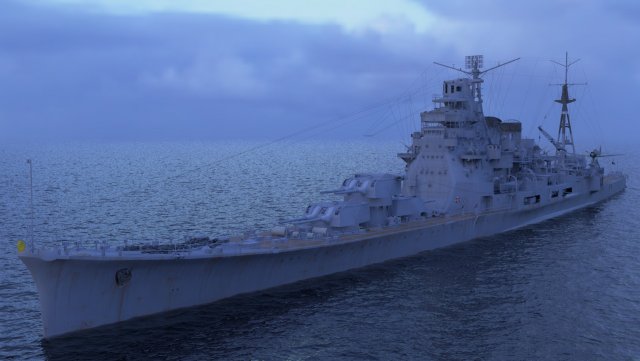
Cruiser Atago with Mitsubishi A6M2 Zero 3D Model
Atago was the second vessel in the Takao-class heavy cruisers, active in World War II with the Imperial Japanese Navy. These were among the largest and most modern cruisers in the Japanese fleet, designed with the intention to form the backbone of a multipurpose long-range strike force. Her sister ships were Takao, Maya and Chokai.Textures from 256×256 to 4096x4096Diffuse, Opacity.
-
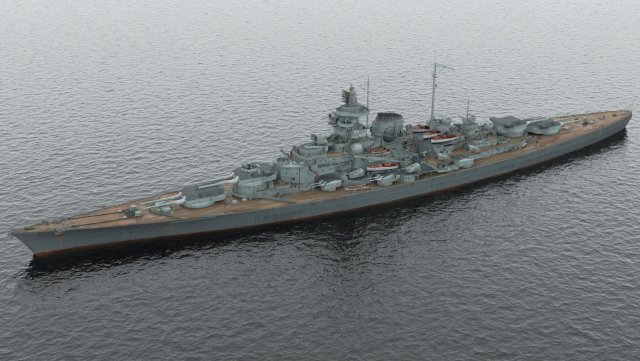
German battleship Tirpitz 3D Model
Tirpitz was the second of two Bismarck-class battleships built for Nazi Germany’s Kriegsmarine during World War II. Named after Grand Admiral Alfred von Tirpitz, the architect of the Kaiserliche Marine, the ship was laid down at the Kriegsmarinewerft Wilhelmshaven in November 1936 and her hull was launched two and a half years later. Work was completed in February 1941, when she was commissioned into the German fleet. Like her sister ship Bismarck, Tirpitz was armed with a main battery of eight 38-centimetre guns in four twin turrets. After a series of wartime modifications she was 2,000 tonnes heavier than Bismarck, making her the heaviest battleship ever built by a European navy.Units scale: meters.Textures: from 256 to 4096Diffuse, Opacity.
-
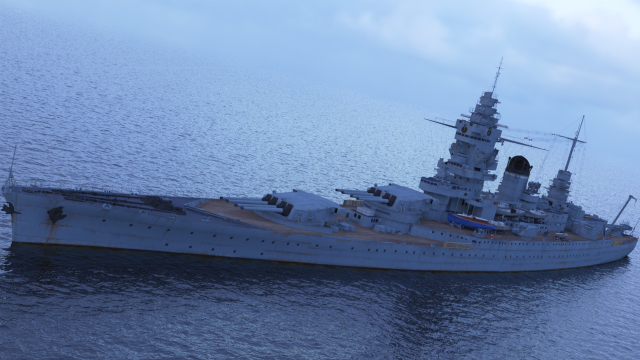
Dunkerque battleship 3D Model
The Dunkerque-class battleship was a type of warship constructed for the French Navy in the 1930s.The Dunkerques were designed to counter the German Deutschland-class pocket battleships. Their main armament was two quadruple 330 mm turrets forward, with a 225 mm (8.9 in) thick armored belt. They were smaller, with a 26,500- to 27,300-ton standard displacement and a smaller main artillery caliber, than the battleships authorized by the Washington Naval Treaty, but their speed was 7 knots higher than any of the battleships built from 1920 to 1937. When they were commissioned, only the last existing battlecruisers of the British Royal Navy and the Imperial Japanese Navy were their equals.Given their characteristics, they were alternatively classified as fast battleships, small battleships, battlecruisers, and even as “ships of the line” (Fr. navires de ligne).Two ships, Dunkerque and Strasbourg, were completed. Together they formed the 1ere Division de Ligne (“1st Division of the Line”), and saw service during the early years of the Second World War. While they never encountered the German pocket battleships they were designed to counter, they suffered the British attack of Mers-el-Kebir, and stayed under the Vichy authorities control until they were scuttled at Toulon in November 1942.Textures from 256×256 to 4096×4096 DDS/JPGDiffuse, Opacity
-
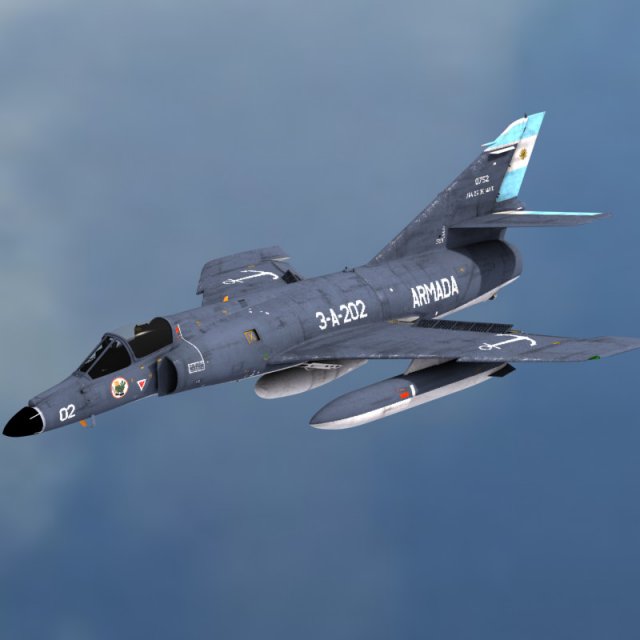
Argentine Naval Aviation Dassault-Breguet Super 3D Model
This model faithfully portraits Super Étendard used by Argentine Navy to sink British destroyer HMS Sheffield and aircraft transporter Atlantic Conveyor during 1982 Falklands War.created in: 3dsmax 2009optimized for: professional system training, high end animation, and still display projects.main product format:1. max 2009 (with scanline setting). It utilizes 3dsMax’s default render engine and does not require any plug-ins.2. max 2009 (with vray setting). This file requires Vray 1.5 plugin (advanced render engine from Chaos Group).texture counts: 58 (pilot, JDAM, AIM-120X comes with individual texture maps.)texture types: diffusion, specular, bump mapstexture sizes: 7000×7000 etc.
-
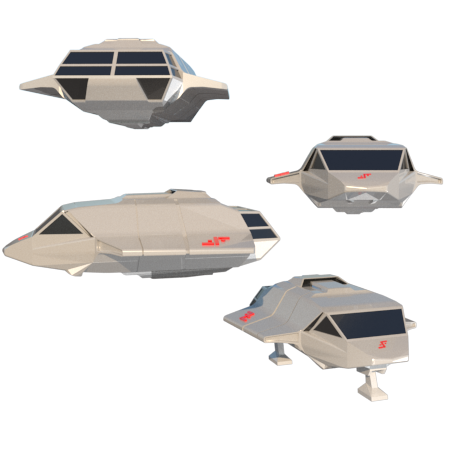
Skyfighter 3D Model
Nave from the television series V the final battle (the vositors) broadcast between 1983 and 1985 in the United States.The ship has a total size of 13.3 cm long, 5.1 cm high and 10 cm wide. Can be scaled to the desired size.You can print the landing gear if you wish, the windows can be printed separately, recommended in black.3D printing settingsNAVERequires supportLayer height: 1.5 mmFilling: 20%.Printing speed: 60 – 70 mm/sPlate adhesion: edgeWall thickness: 1.2 mm or moreUNDERCARRIAGESupport: noLayer height: 1.5 mmFilling: 20%.Printing speed: 60 mm/secPlate adhesion: edgeWall thickness: 1.2 mm or moreGLASSESSupport: noLayer height: 1 mmFilling: 100 %.Printing speed: 60 mm/secPlate adhesion: edgeWall Thickness: 0.8 mm or greater
-
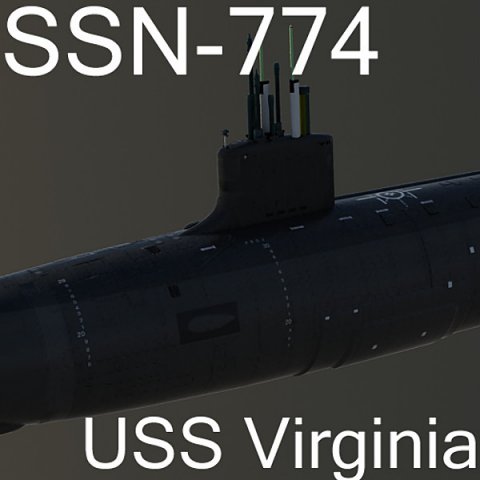
US Navy SSN-774 USS Virginia Attack Submarine 3D Model
Virginia was delivered to the Navy on 12 October 2004, the 104th anniversary of the commissioning of Holland, the Navy’s second submarine. She was commissioned on 23 October 2004 under the command of David J. Kern.As part of the Force Transformation Model Packet by Camelot Inc., this model is made in 3dsMax 9 and ready for any high end animation projects and stilled display projects. All thumbnails are rendered by the .max vray version.Main products include 2 files:1. max 9 (with vray setting). This is the original file and requires Vray 1.5 plugin (advanced render engine from Chaos Group). It’s used to make all the thumbnails.2. max 9 (with scanline setting). It utilizes 3dsMax’s default render engine and does not require any plug-ins.Texture Info: Main textures are 7000 X 7000 sized.
-
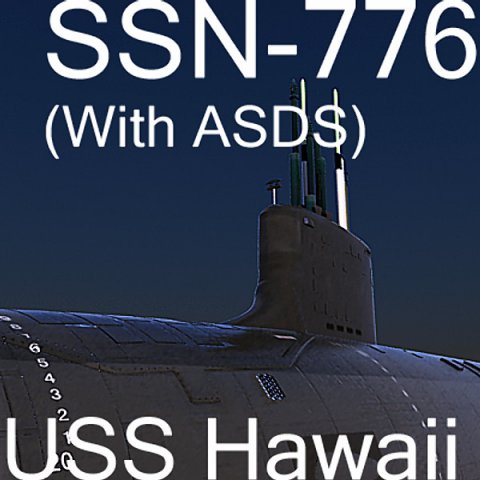
US Navy SSN-776 USS Hawaii Attack Submarine with ASDS 3D Model
USS Hawaii (SSN-776), a Virginia-class submarine, is the only commissioned warship of the United States Navy to be named for the 50th state. She was commissioned on 5 May 2007 with Captain David A. Solms in command.As part of the Force Transformation Model Packet by Camelot Inc., this model is made in 3dsMax 9 and ready for any high end animation projects and stilled display projects. All thumbnails are rendered by the .max vray version.Main products include 4 files:1. max 9 (with vray setting) surface configuration. This is the original file and requires Vray 1.5 plugin (advanced render engine from Chaos Group). It’s used to make all the thumbnails.2. max 9 (with vray setting) submerge configuration. As above.3. max 9 (with scanline setting) surface configuration. It utilizes 3dsMax’s default render engine and does not require any plug-ins.4. max 9 (with scanline setting) submerge configuration. As above.Texture Info: Main textures are 7000 X 7000 sized.
-
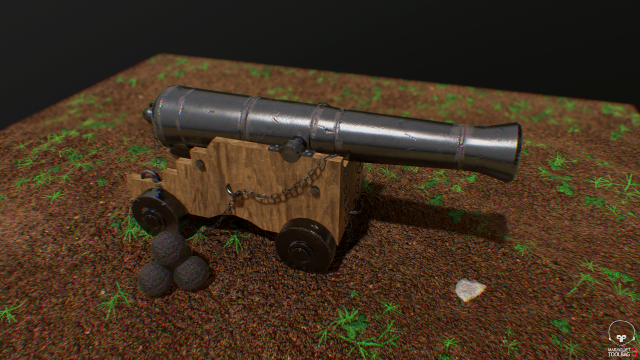
British Naval Cannon 3D Model
An archive contains cannon balls and 2 files with cannon. One with chain and another one without it.Without chain:Polygons: 4170Vertices: 4237Tris: 8132With chain:Polygons: 21330Vertices: 20539Tris: 40164Everything with textures.
-
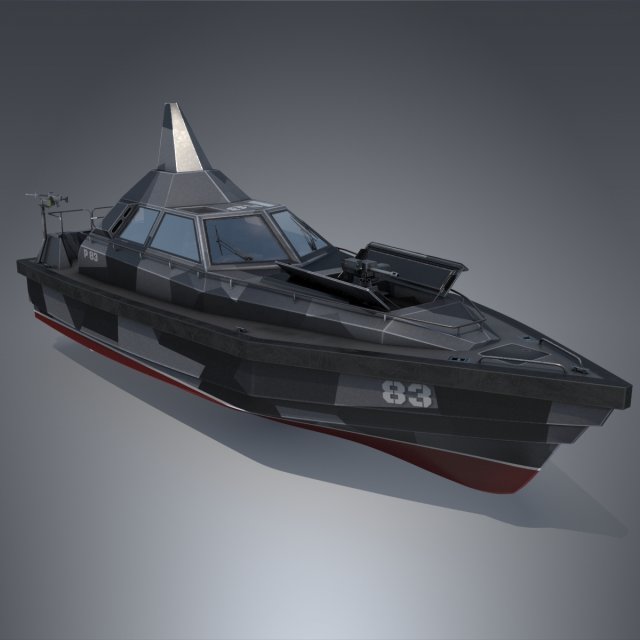
Stealth Patrol Boat 3D Model
High quality 3D model of stealth patrol boat interceptor BarracudaThe model was originally modeled in hard surface technic in 3ds Max, textured with Substance Painter and rendered with V-Ray and Marmoset.FEATURESPBR materials.Model correctly scaled for an accurate representation of the original object.Intended for subdivisionQuads only.Clean topology and perfect uv.Model was builded in real world scale on metric unit system (meters)Model is fully textured with all materials applied.Textures and materials are included and mapped in both format.No cleaning up necessary just drop your models into the scene and start rendering.Textures:-boat texture 4096*4096 (albedo, gloss, specular, normal)-interior 2048*2048 (albedo, gloss, specular, normal)-weapons (2 x M249 SAW and MK-19 grenade launcer) texture 4096*4096 (albedo, gloss, specular, normal)- glass 1024*1024 (albedo, gloss, specular, normal)- added metalness-roughtness + AO texture set- added specular-gloss + AO texture setFORMATS- 3ds Max 2015 Vray- 3ds Max 2015 Scanline- Cinema4d- .obj- .fbx multiformatQuality guaranteed.
-
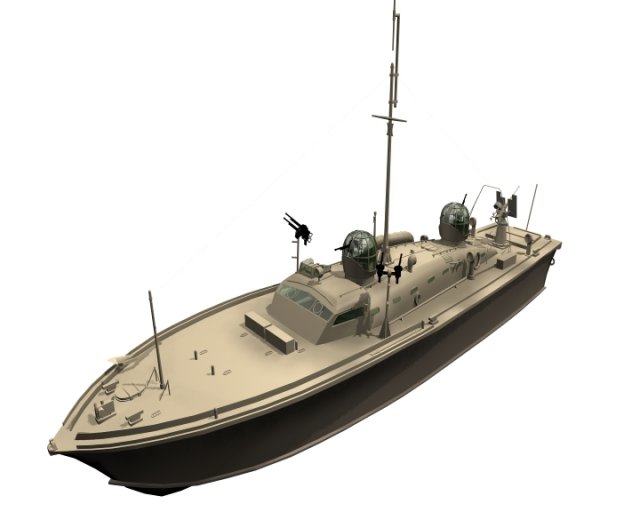
Usa fleet demora assault ship 3D Model
Small navy boat 3d model, vessel military, usa fleet usa demora assault ship.
-
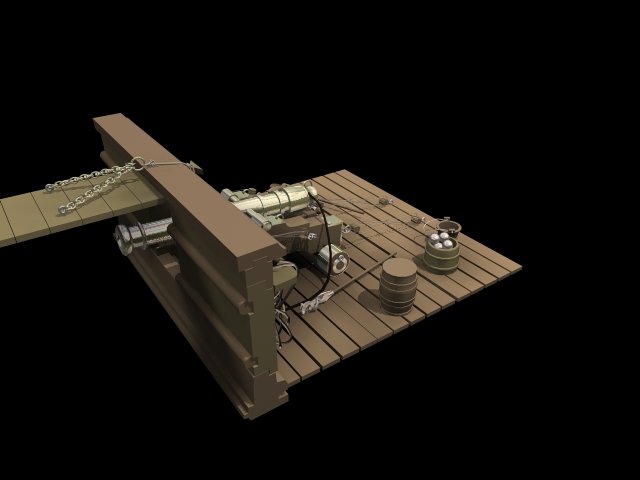
Cannon and Gun Deck 3D Model
A highly detailed cannon and gun deck from a wooden sailing ship. Includes rigging, some tools and a powderhorn.
-
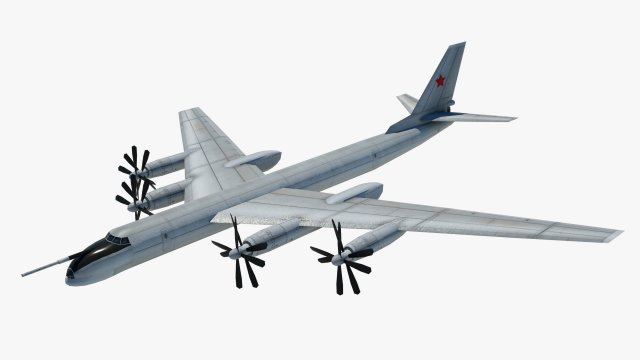
Tupolev Tu-142 3D Model
Tupolev Tu-142 low-poly 3d model ready for Virtual Reality (VR), Augmented Reality (AR), games and other real-time apps.Tupolev Tu-142 (NATO reporting name: Bear F/J) is a maritime reconnaissance and anti-submarine warfare (ASW) aircraft derived from the Tu-95 turboprop strategic bomber.Model is polygonal.No mess with materials.Model is completely textured. It containsstandard 3ds Max materials and 1 BMP format textureTexture size : 2048x2048Real world scale-Scene unit scale: meters- Scene does not contain foreign objects such as cameras and light sources and so on.Renderer for preview used: Octane Render 3.06.4 (not included)
-
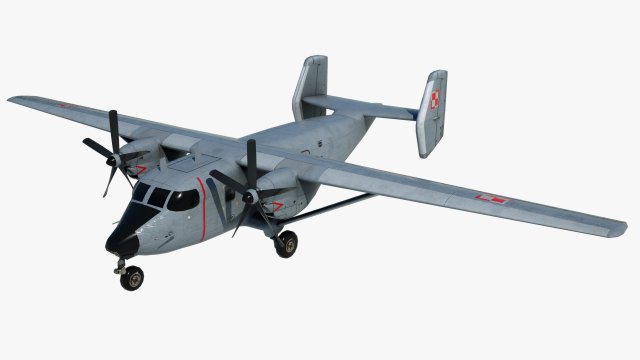
Cargo and passenger plane M-28-Bryza 3D Model
Cargo and passenger plane M-28-Bryza low-poly 3d model ready for Virtual Reality (VR), Augmented Reality (AR), games and other real-time apps.M-28-Bryza – is a Polish STOL light cargo and passenger plane, produced by PZL Mielec, as a development of license-built Antonov An-28.Model is polygonal.No mess with materials.Model is completely textured. It containsstandard 3ds Max materials and 1 BMP format textureTexture size : 1024x1024Real world scale-Scene unit scale: meters- Scene does not contain foreign objects such as cameras and light sources and so on.Renderer for preview used: Octane Render 3.06.4 (not included)
-
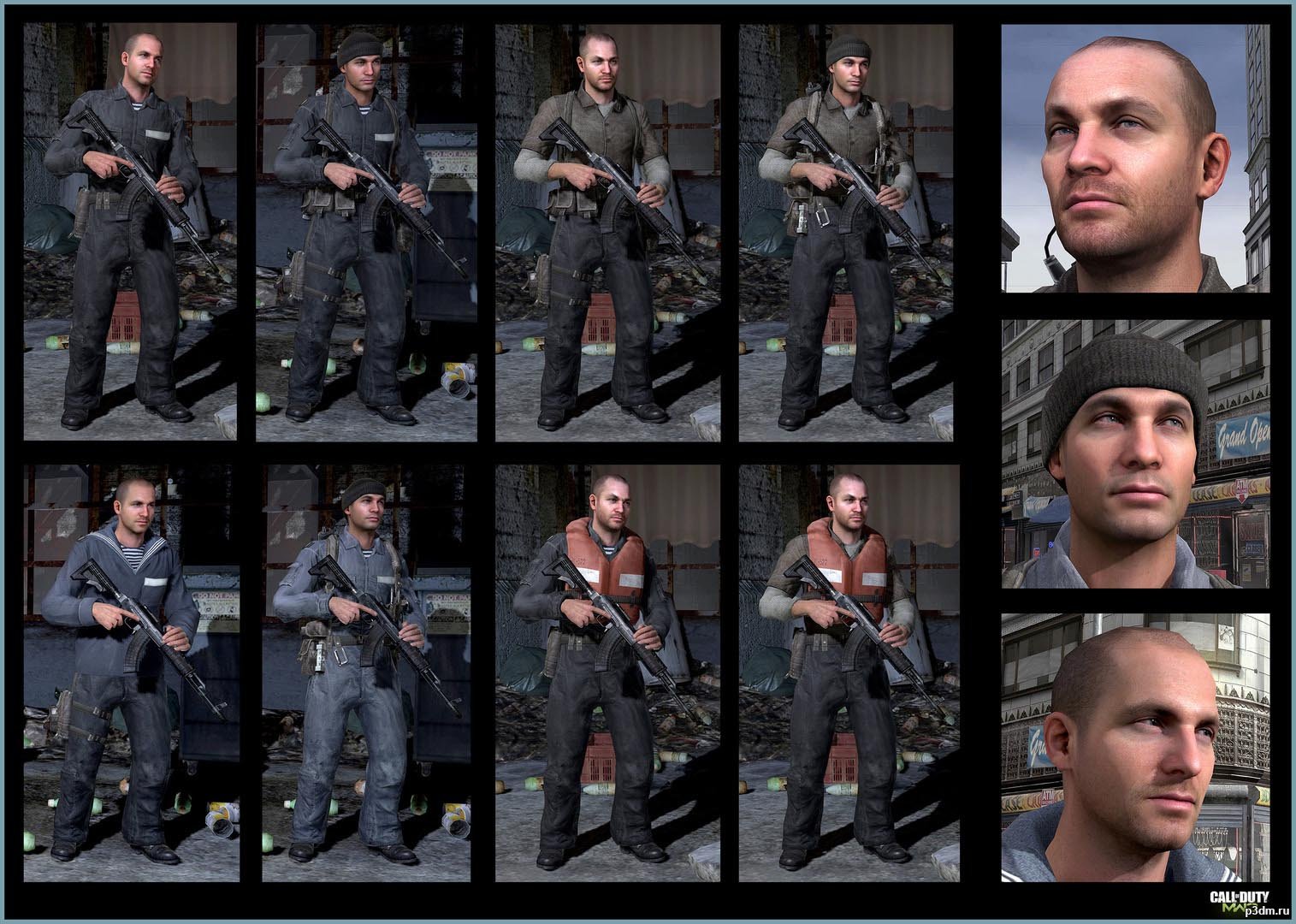
Russian Navy Crew 3D Model
Модели моряков военно-морского флота России из Call Of Duty: Modern Warfare 3. В архиве доступны все варианты голов и тел моряков (присутствуют различные модели одежды и формы, в т.ч. высшего офицерского состава), а так же некоторых солдат ВМФ. В файлах формата ma имеются встроенные скелеты.* * *Особая благодарность Андрею Мозговому за помощь в извлечении моделей.
-
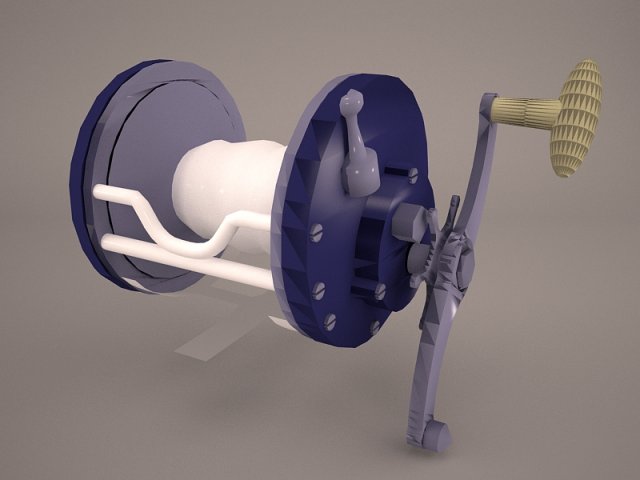
Windlass 3D Model
windlass ship capstan deck vessel old steam navy marine equipment anchor chain mooring industrial mechanism tool reel
-
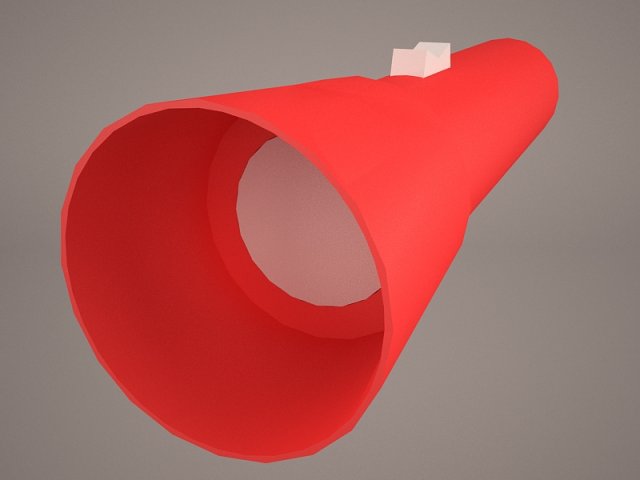
Flashlight Free 3D Model
Pistol Flaslight Generic tactical light navy seal lumens accessories glock 19 ammunition military army sas rainbow six battlefield
-
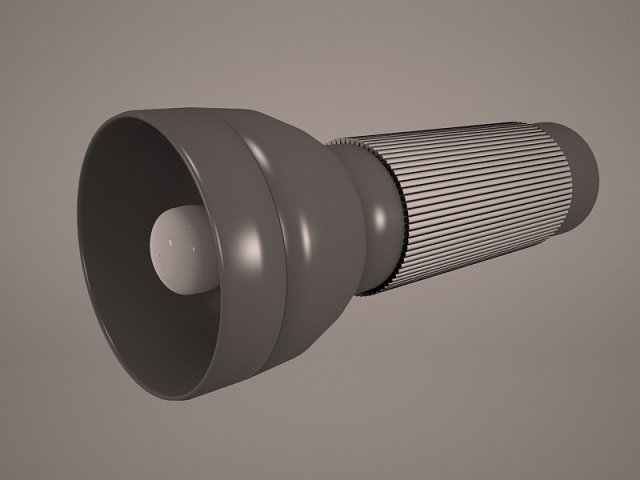
Flashlight 3D Model
Pistol Flaslight Generic tactical light navy seal lumens accessories glock 19 ammunition military army sas rainbow six battlefield
-
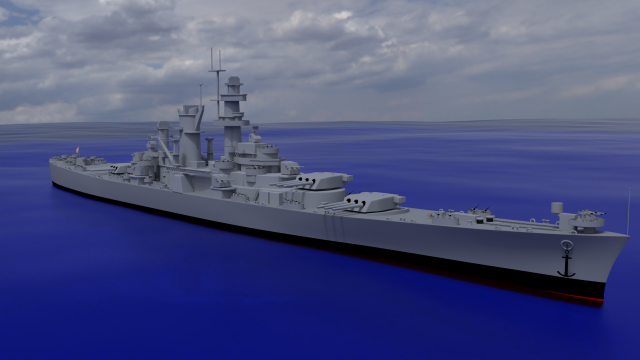
USS Alaska CB-1 Battle Cruiser 3D Model
3d model of the USS Alaska. The Alaska was commissioned in 1944 and served in the US Navy in WW2. The ship was stationed in the Pacific.Highly detailed.Modeled in Blender and rendered in Cycles.Exported to:OBJ -WavefrontFBX -Autodesk3ds -3D MaxBlend -blenderModeled from blueprints.
-
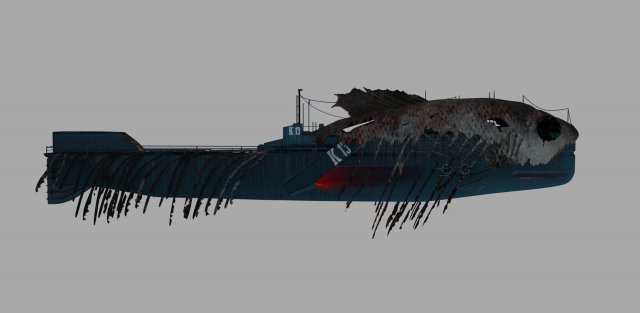
Submarine camouflaged with fish skin – Queen of Depths 3D Model
Submarine camouflaged with fish skin – Queen of Depths 3D modelYear 1947. After World War II many nuclear bombs fell into the oceans. All living organisms grew to enormous sizes and turned from prey to hunters. The people who survived the war must now take back the control of the oceans – they use the rest of the machinery from the war era, such as old submarines and camouflage them with giant fish skins. One crew needs to go trough an old, but functional naval minefield. Divers riding on “Mine Seekers” are trying to spot the mines and lead the submarine safely through. The dark depths seem calm and void of life, but that is just an illusion, because – HUNTERS NEVER SLEEP …..Model of fictional submarine covered with giant fish skin as camouflage. Unwraped very high detailHope u will like it
-
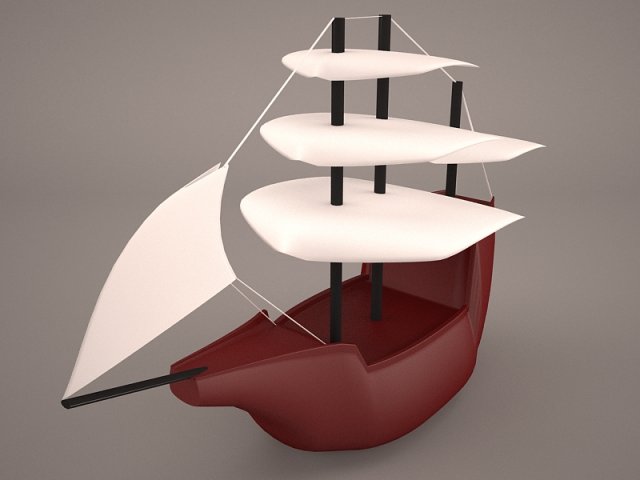
Great dutch Ship 3D Model
dutch galiot collection pack galleon ship frigate sails kit sail sea ocean marine boat historical legendary historic vessel navy xebec galeas steam
-
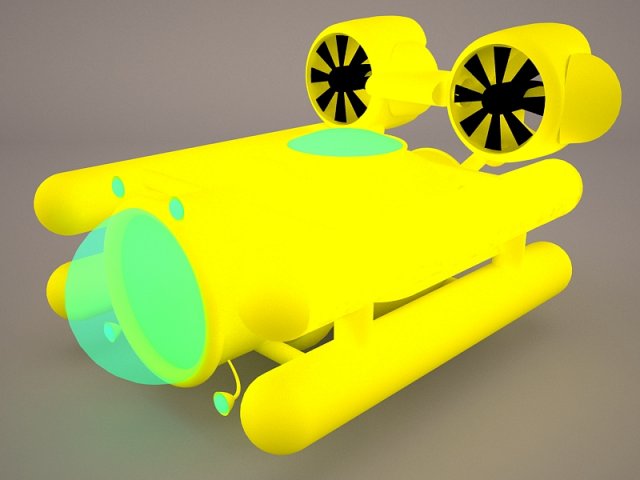
USS Dallas SSN 700 with Dry Deck Shelter 3D Model
Oscar II submarine sub torpedo military LA 688 Flight1 los angeles class MK48 USN Navy underwater USS Dallas SSN SSN-700 dry deck shelter deep sea
-
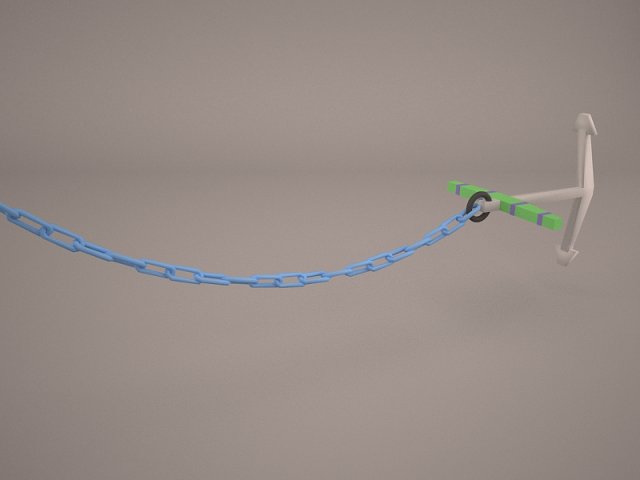
Anchor 3D Model
anchor anchors ancient boat yacht ship sail navy accessory accessories hardware equipment danforth realistic 3d model
-
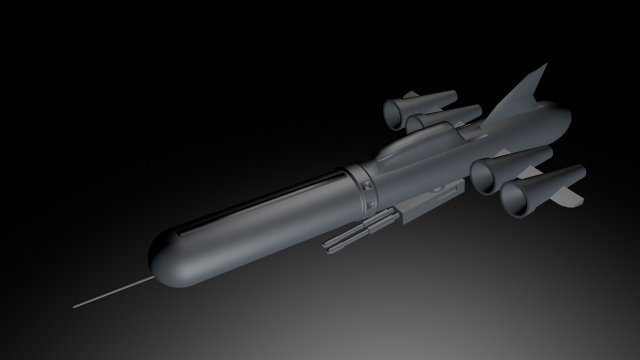
Warcraft Submarine 3D Model
Warcraft SubmarineAvailable formate:*FBX*OBJ*stl*3ds*C4dThanks for view this 3d model..please visit my portfolio to get more 3d models
-
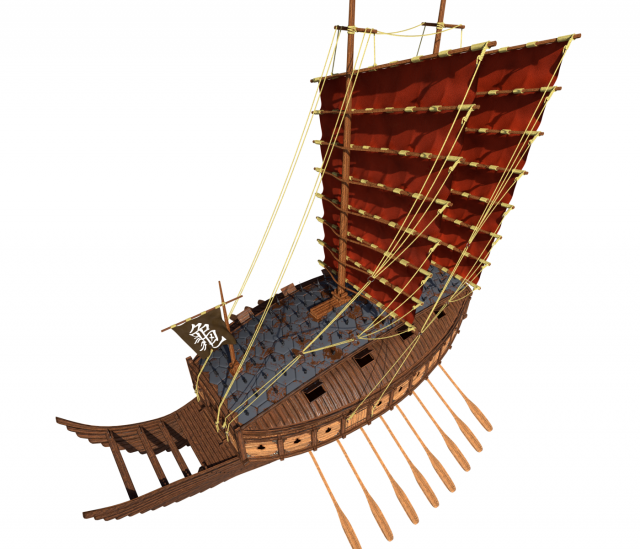
Turtle ship 3D Model
This is a highly polygonal 3D model of a medieval Korean turtle shipCreated in Blender 3D v2.79, Cycles RenderThe model is highly accurate.This is a realistic 3D model, the materials and textures are included.
-
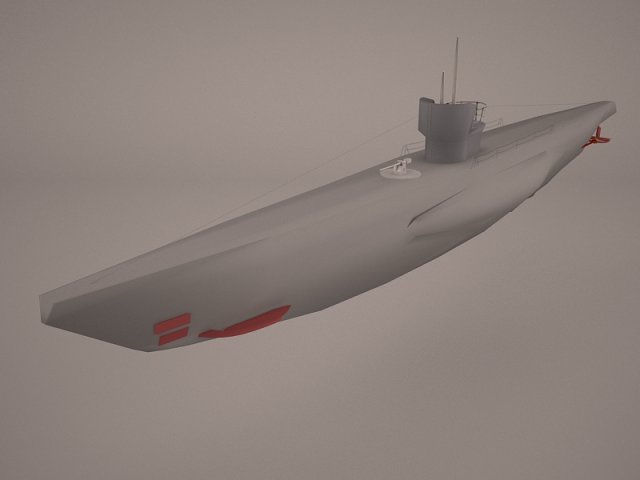
USS Dallas SSN 700 with Dry Deck Shelter 3D Model
Oscar Boat VII submarine sub torpedo military LA 688 Flight1 los angeles class MK48 USN Navy underwater USS Dallas SSN SSN-700 dry deck shelter
-
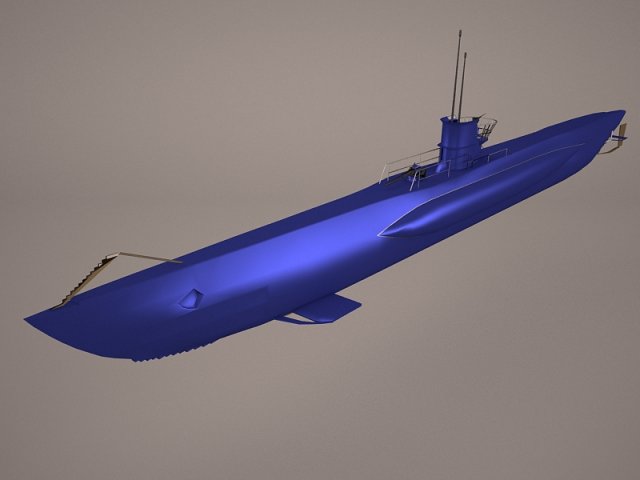
USS Dallas SSN 700 with Dry Deck Shelter 3D Model
Oscar II submarine sub torpedo military LA 688 Flight1 los angeles class MK48 USN Navy underwater USS Dallas SSN SSN-700 dry deck shelter
-
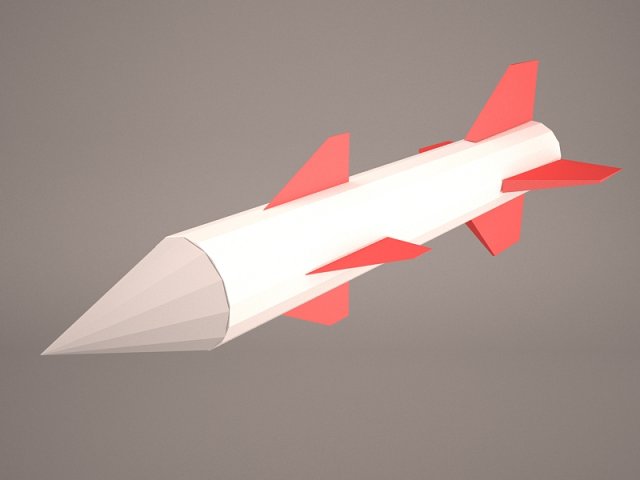
AIM-120 AMRAAM 3D Model
AIM-120 AIM120 AIM AMRAAM Missile to Air Force Jet Slammer Rocket Navy Army Weapon Bomb Armor military marines projectiles patriot scod
-
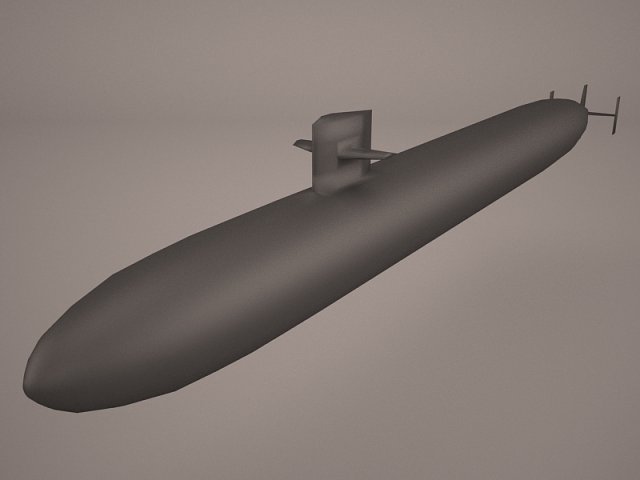
USS Dallas SSN 700 with Dry Deck Shelter 3D Model
Oscar II submarine sub torpedo military LA 688 Flight1 los angeles class MK48 USN Navy underwater USS Dallas SSN SSN-700 dry deck shelter
-
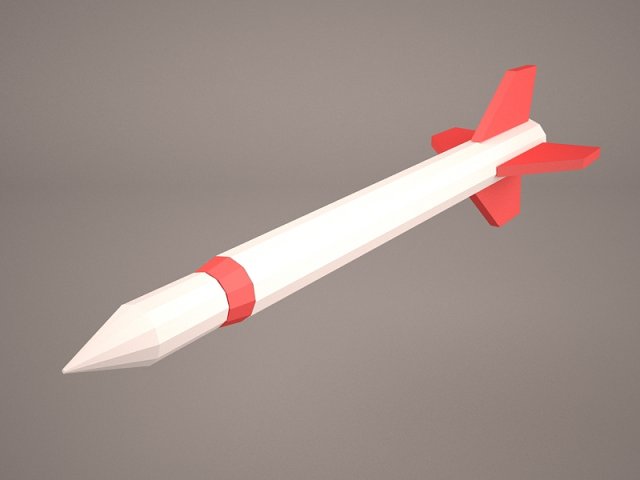
AIM-120 AMRAAM 3D Model
AIM-120 AIM120 AIM AMRAAM Missile to Air Force Jet Slammer Rocket Navy Army Weapon Bomb Armor military marines projectiles patriot scod
-
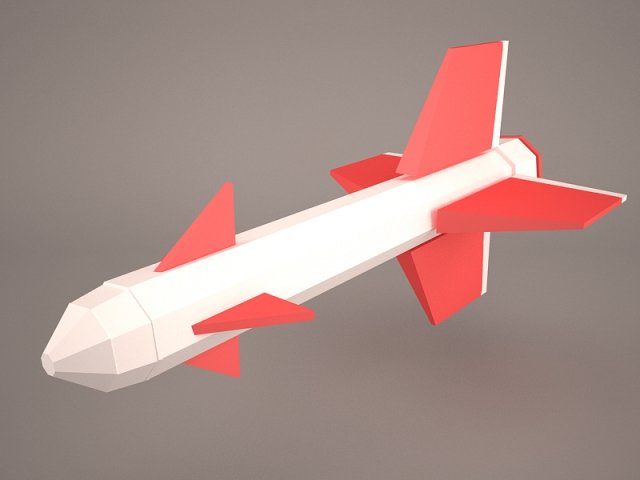
AIM-120 AMRAAM 3D Model
AIM-120 AIM120 AIM AMRAAM Missile to Air Force Jet Slammer Rocket Navy Army Weapon Bomb Armor military marines projectiles patriot
-
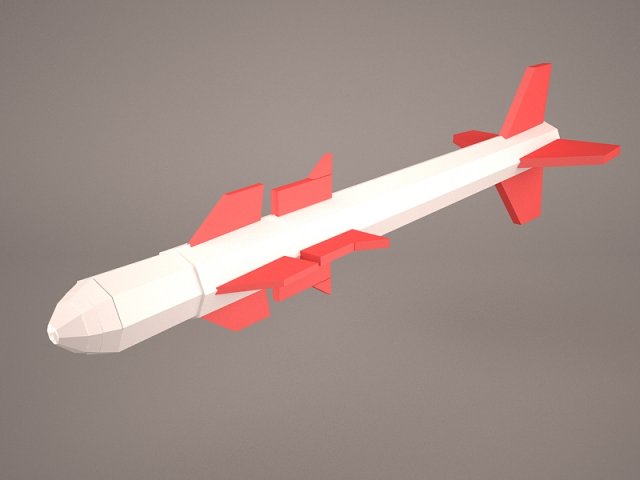
AIM-120 AMRAAM 3D Model
AIM-120 AIM120 AIM AMRAAM Missile to Air Force Jet Slammer Rocket Navy Army Weapon Bomb Armor military marines projectiles patriot
-
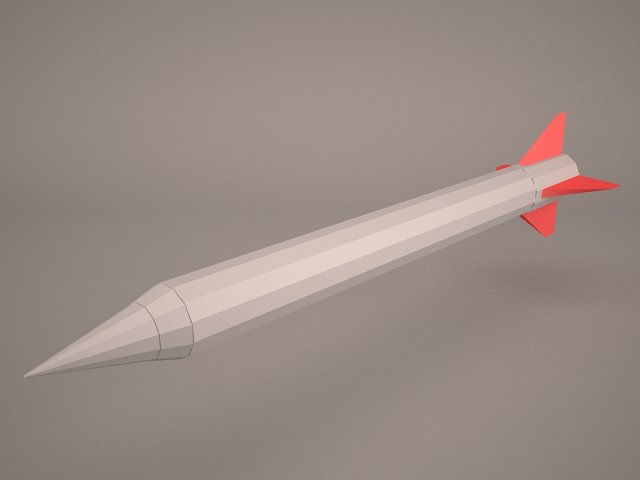
AIM-120 AMRAAM 3D Model
AIM-120 AIM120 AIM AMRAAM Missile to Air Force Jet Slammer Rocket Navy Army Weapon Bomb Armor military marines projectiles patriot