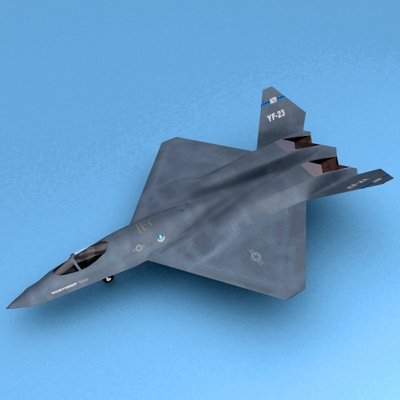
The Northrop/McDonnell Douglas YF-23 was a prototype fighter aircraft designed for the United States Air Force. It was passed over in favor of the YF-22.
Tag: mcdonnell
-
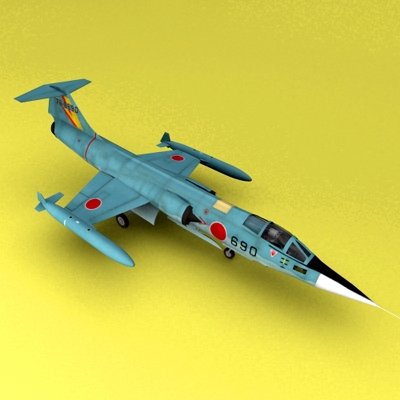
F-104 Starfighters 3D Model
Because of its physical appearance and performance, the F-104 has often been called the ‘missile with a man in it.’ The design was a product of the Korean War, and was unique in several respects. The encounters with the MiG-15 in Korea caused a strong outcry among Air Force fighter pilots for a cheap, lightweight, maneuverable, high-performance fighter to confront future Soviet fighters. The result was the F-104, a fighter that overemphasized rate of climb and brute speed. Intended as a point defense interceptor, range was sacrificed for rate of climb. Range, however, could be extended using external tanks and in-flight refueling. It used an exceptionally small wing span of only 21 feet, and provided low speed lift through air bled from the engine and vented over the wing. Designed as a supersonic superiority fighter, the F-104 was produced in two major versions. Armed with a six-barrel M-61 20mm Vulcan cannon it served as a tactical fighter and, equipped additionally with heat-seeking Sidewinder missiles, as a day-night interceptor. The USAF procured about 300 Starfighters in one- and two-seat versions. The texture is for JASDF.
-
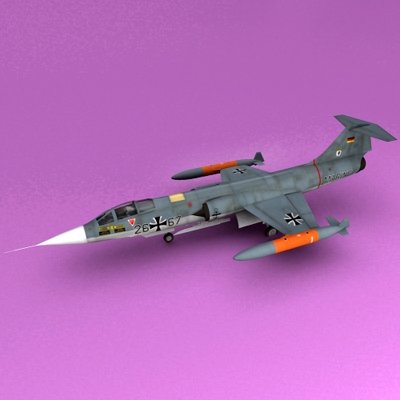
F-104 3D Model
Because of its physical appearance and performance, the F-104 has often been called the “missile with a man in it.” The design was a product of the Korean War, and was unique in several respects. The encounters with the MiG-15 in Korea caused a strong outcry among Air Force fighter pilots for a cheap, lightweight, maneuverable, high-performance fighter to confront future Soviet fighters. The result was the F-104, a fighter that overemphasized rate of climb and brute speed. Intended as a point defense interceptor, range was sacrificed for rate of climb. Range, however, could be extended using external tanks and in-flight refueling. It used an exceptionally small wing span of only 21 feet, and provided low speed lift through air bled from the engine and vented over the wing. Designed as a supersonic superiority fighter, the F-104 was produced in two major versions. Armed with a six-barrel M-61 20mm Vulcan cannon it served as a tactical fighter and, equipped additionally with heat-seeking Sidewinder missiles, as a day-night interceptor. The USAF procured about 300 Starfighters in one- and two-seat versions. The texture is for Germany Marine.
-
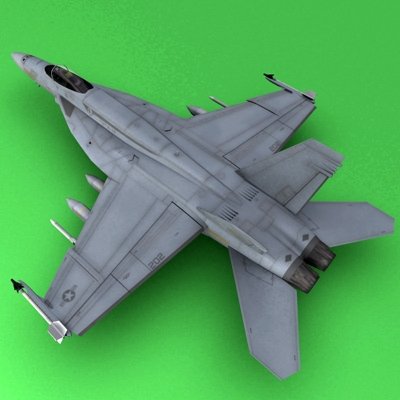
F-18E 3D Model
The combat-proven F/A-18E Super Hornet is a next generation strike fighter with all the capability, flexibility and performance necessary to modernize the air or naval aviation forces of any country. Built by the industry team of Boeing, Northrop Grumman, GE Aircraft Engines, Raytheon and more than 2,000 suppliers nationwide, the Super Hornet embodies the newest advances in multimission capability and decades of growth potential.
-

F-18E-F Super Hornet 3D Model
f-18 f/a-18 f/a-18e f/a-18f f/a-18g f18 f18e super hornet carrier fighter bomber prowler growler jammer boeing mcdonnell douglas us navy marine corps
-
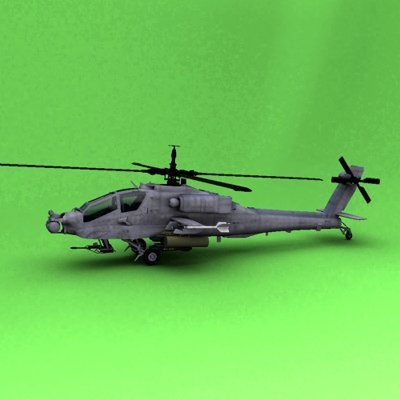
Apache 3D Model
The Apache was developed by McDonnell Douglas to meet a U.S. army requirement for a day/night all weather anti armor ground support attack aircraft with a high potential for survival in the battlefield. The first flight took place on September 30, 1975, with production deliveries to the U.S. Army starting on January 1984. Taking a major part in the Gulf War, it has also been used in Panama, Somalia and other theaters of operation. The texture is for US Army.
-
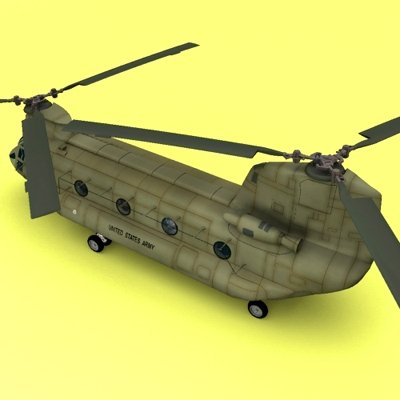
Ch-47 US Army 3D Model
The CH-47 Chinook, the workhorse of the US Army, is manufactured by the Boeing Vertol company. The Chinook has served as the prime mover for the US Army and other military forces for decades. Its principal missions include transport of troops, artillery, ammunitions, fuel, water, barrier materials, supplies and equipment on the battlefield. Other missions include medical evacuation, aircraft recovery, fire fighting, parachute drops, heavy construction, civil development, disaster relief, and search and rescue. In the US Army National Guard and among international customers, Chinooks often expend the majority of their flight hours on these latter missions.
-
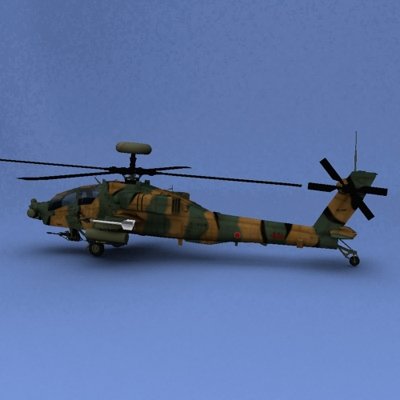
AH-64 Apache JASDFD 3D Model
AH-64DJ for JASDF(Japan Air Self-Defense Force). According to the report that Boeing authorized the Japanese company Fuji Heavy Industries (FHI) Utsunomiya NASA factory to produce AH-64DJ U.S. Army AH-64D ‘Bow Apache,’ the Japanese improved version. AH-64DJ JGSDF service will replace the AH-1S ‘Cobra’ helicopter as the main anti-Japan’s future Tanks / helicopter gunships.AH-64DJ equipped with the AIM-92 ‘Stinger’ air-to-air missiles and all millimeter-wave radar, air combat capability and survivability during wartime is better than AH-1S.
-
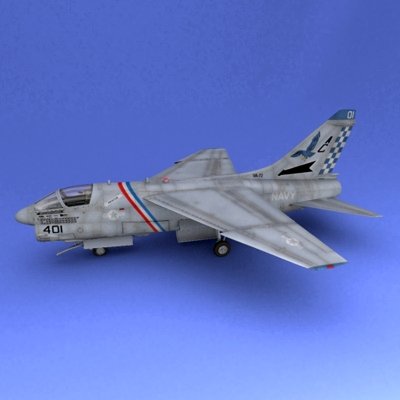
A-7 3D Model
Built originally on the airframe of the F-8U Crusader, the A-7 underwent a number of modifications since its 1965 introduction. The A-7 Corsair II, which is retired, was used by TAC for close air support attack missions. The A-7E was the final fleet version of the A-7. After more than two decades of service, however, it was replaced by the F/A-18 Hornet.The A-7E had a 20mm gun and can carry payloads of up to 15,000 pounds of bombs and missiles. Eight ordnance stations were available. A-7E Corsair IIs were part of the two-carrier battle group that conducted a joint strike on selected Libyan terrorist-related targets in 1986. Together with carrier-based F/A-18s, A-7s used anti-radiation missiles to neutralize Libyan air defenses. F/A-18s replaced A-7Es in the carrier air wing mix. The last two squadrons transitioned in FY 1992. Replacing A-7s with F/A-18s gave operational commanders more flexibility by allowing them to employ the F/A-18s in either the fighter or attack role. Also, a smaller number of aircraft (85) are needed in an F/A-18 equipped carrier air wing than in an A-7E equipped carrier air wing (94).
-
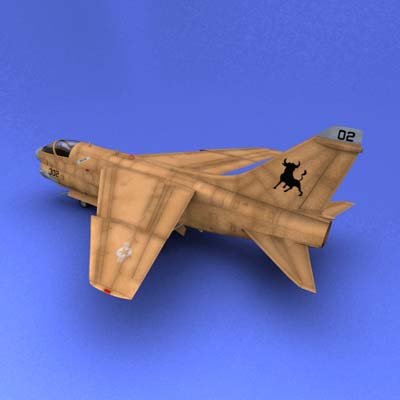
A-7 3D Model
Built originally on the airframe of the F-8U Crusader, the A-7 underwent a number of modifications since its 1965 introduction. The A-7 Corsair II, which is retired, was used by TAC for close air support attack missions. The A-7E was the final fleet version of the A-7. After more than two decades of service, however, it was replaced by the F/A-18 Hornet.The A-7E had a 20mm gun and can carry payloads of up to 15,000 pounds of bombs and missiles. Eight ordnance stations were available. A-7E Corsair IIs were part of the two-carrier battle group that conducted a joint strike on selected Libyan terrorist-related targets in 1986. Together with carrier-based F/A-18s, A-7s used anti-radiation missiles to neutralize Libyan air defenses. F/A-18s replaced A-7Es in the carrier air wing mix. The last two squadrons transitioned in FY 1992. Replacing A-7s with F/A-18s gave operational commanders more flexibility by allowing them to employ the F/A-18s in either the fighter or attack role. Also, a smaller number of aircraft (85) are needed in an F/A-18 equipped carrier air wing than in an A-7E equipped carrier air wing.
-
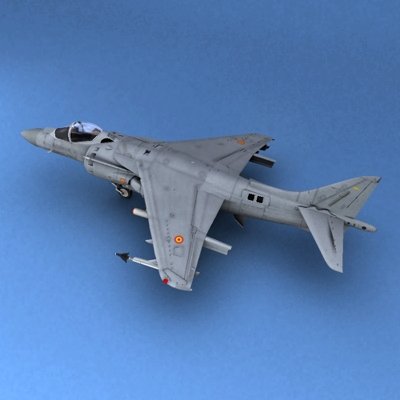
AV-8 Spanish 3D Model
The AV-8B Harrier II Plus is a multi-mission, short-takeoff vertical landing (STOVL) tactical strike aircraft. Because of its short-to-vertical takeoff and landing characteristics, it possesses basing flexibility that is unmatched by other fixed-wing aircraft. Furthermore, it supports a broad selection of air-to-air and air-to-surface weapon systems and third-generation technologies that address diverse tactical scenarios. This texture is for Spanish Air Force.
-
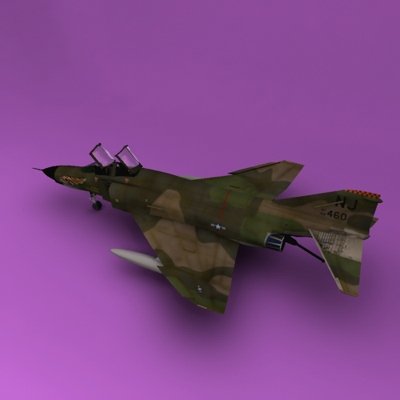
F-4 3D Model
The F-4 Phantom II was a twin-engine, all-weather, fighter-bomber. The aircraft could perform three tactical air roles — air superiority, interdiction and close air support — as it did in southeast Asia. First flown in May 1958, the Phantom II originally was developed for U.S. Navy fleet defense and entered service in 1961. The USAF evaluated it for close air support, interdiction, and counter-air operations and, in 1962, approved a USAF version. The USAF’s Phantom II, designated F-4C, made its first flight on May 27, 1963. Production deliveries began in November 1963. In its air-to-ground role the F-4 could carry twice the normal bomb load of a WW II B-17. USAF F-4s also flew reconnaissance and “Wild Weasel” anti-aircraft missile suppression missions. Phantom II production ended in 1979 after over 5,000 had been built–more than 2,600 for the USAF, about 1,200 for the Navy and Marine Corps, and the rest for friendly foreign nations, including to Israel, Iran, Greece, Spain, Turkey, South Korea, West Germany, Australia, Japan, and Great Britain. Used extensively in the Vietnam War, later versions of the aircraft were still active in the U. S. Air Force inventory well into the 1990s. F-4s are no longer in the USAF inventory but are still flown by foreign nations. This texture is for U.S Air Force.
-
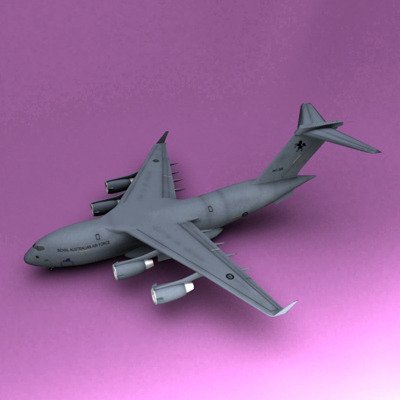
C-17 Australia 3D Model
On 3 April 2006, the Defense Security Cooperation Agency notified Congress of a possible Foreign Military Sale to Australia of up to four C-17 GLOBEMASTER III aircraft, as well as associated equipment and services. The total value, if all options are exercised, could be as high as $2 billion. The C-17 is the newest airlift aircraft to enter the Air Force’s inventory. The C-17 is capable of rapid strategic delivery of troops and all types of cargo to main operating bases or directly to forward bases in the deployment area. The aircraft is also able to perform theater airlift missions when required.
-
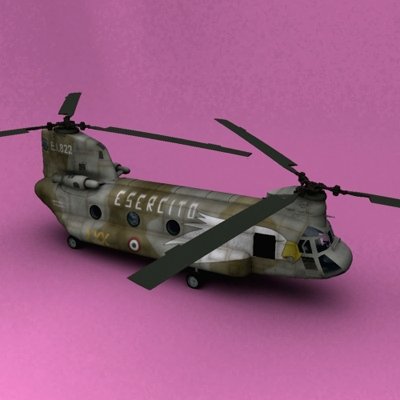
Ch-47 Italy 3D Model
The CH-47 Chinook, the workhorse of the US Army, is manufactured by the Boeing Vertol company. The Chinook has served as the prime mover for the US Army and other military forces for decades. Its principal missions include transport of troops, artillery, ammunitions, fuel, water, barrier materials, supplies and equipment on the battlefield. Other missions include medical evacuation, aircraft recovery, fire fighting, parachute drops, heavy construction, civil development, disaster relief, and search and rescue. In the US Army National Guard and among international customers, Chinooks often expend the majority of their flight hours on these latter missions. This texture is for Italy Army.
-
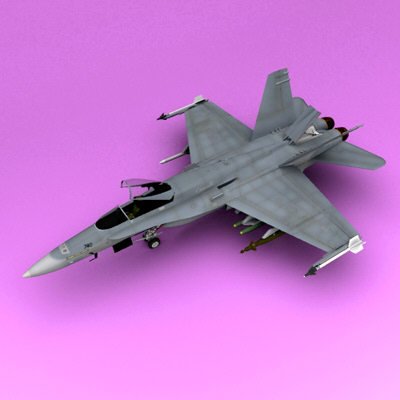
Cf-18 3D Model
The CF-18 is a multipurpose, high-performance twin-engine fighter that can equally well handle air-to-air (air defence, air superiority, combat air patrol, etc.) or ground-attack (close air support, battlefield air interdiction, etc.) roles, aided by on-board computer systems that can be quickly re-programmed to the mission at hand. (Note: The CF-18 is officially designated the “CF188” in Canadian use, although that identity is rarely employed except in the most official or technical documentation.)
-
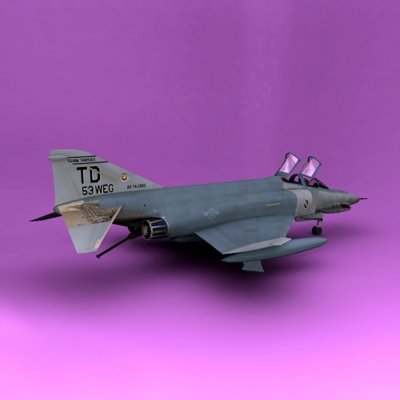
F-4E 3D Model
The F-4 was designed in 1958 as a company venture by McDonnell Douglas to meet future needs and it turned into the greatest post World War II fighter ever built. Considered by some the fastest, most versatile and effective aircraft ever built. The F-4 was initially designed as an attack bomber without internal weapons. The Phantom carried a greater bomb load than a B-29, yet was an effective fighter shooting down 106 out of 137 Migs destroyed in the Vietnam War. Israel has used F-4’s in all of its major confrontations, at one time shooting down over 70 Syrian aircraft without a Phantom lost. The F-4E was flown by the US Air Force Demonstration team The Thunderbirds from 1969 through the mid 1970’s. F-4E’s were also flown as aircraft known as Wild Weasels and were active in the Persian Gulf War.
-
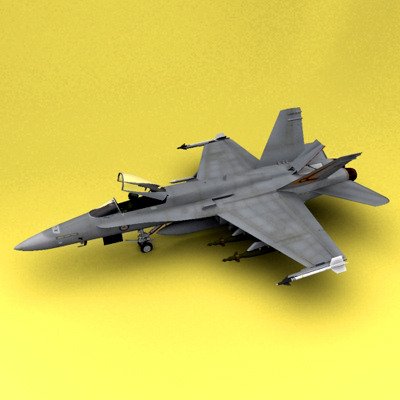
F-18 Australia Air Force 3D Model
Following a successful run of more than 400 A and B models, the US Navy began taking fleet deliveries of improved F/A-18C (single seat) and F/A-18D (dual seat) models in September 1987. These Hornets carry the Advanced Medium Range Air-to-Air Missile (AMRAAM) and the infrared imaging Maverick air-to-ground missile. Two years later, the C/D models came with improved night attack capabilities. The new components included a navigation forward looking infrared (NAVFLIR) pod, a raster head-up display, night vision goggles, special cockpit lighting compatible with the night vision devices, a digital color moving map and an independent multipurpose color display. This texture is for Royal Australia Air Force.
-
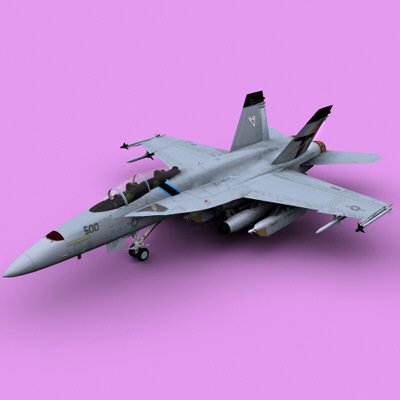
Ea18g 3D Model
The EA-18G Airborne Electronic Attack (AEA) system was selected by the U. S. Navy to replace the EA-6B Prowler aircraft. A variant of the U.S. Navy F/A-18F two-crew strike fighter, the EA-18G combines the combat-proven F/A-18F strike fighter with the proven Improved Capability III (ICAP III) AEA avionics suite. LOCAAS(Low Cost Autonomous Attack System) is also inclued as a separated file.
-
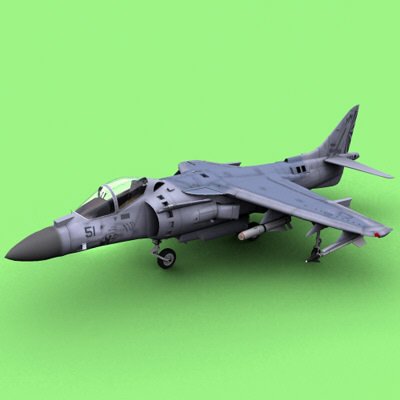
AV-8B Harrier II plus 3D Model
AV-8B Harrier II plus. Two textures are included in the model, one belongs to VMA-231 ‘Ace of Spades’, the other belongs to VMA-223 ‘Bulldogs’ which has a unique shark tatoo.
-
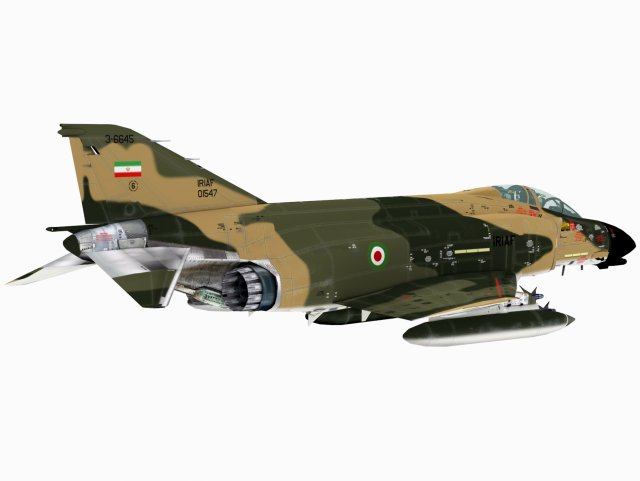
McDonnell Douglas F-4 D Phantom Iranian Air Foprce scheme 3D Model
The F-4D joined combat forces in Southeast Asia in May 1967. The F-4D relegated most of the F-4Cs to the ground attack role while the F-4Ds were tasked with air to air interception duties. In addition to the AIM-7 Sparrow and AIM-9 Sidewinder, the F-4D was also capable of firing the Falcon missile. The Falson missile proved to be a failure, and after a brief trial period it was withdrawn from Vietnam combat service. The F-4 proved its worth in combat 05 June 1967, when a crew from the 555th Tactical Fighter Squadron downed a MiG-17 with an AIM-7 Sparrow missile. F-4Ds were the first aircraft to use laser guided munitions carrying GBU-1O/B Mk 84 Laser guided bombs in May 1968. USAF F-4s also flew reconnaissance and “Wild Weasel” anti-aircraft missile suppression missions.
-
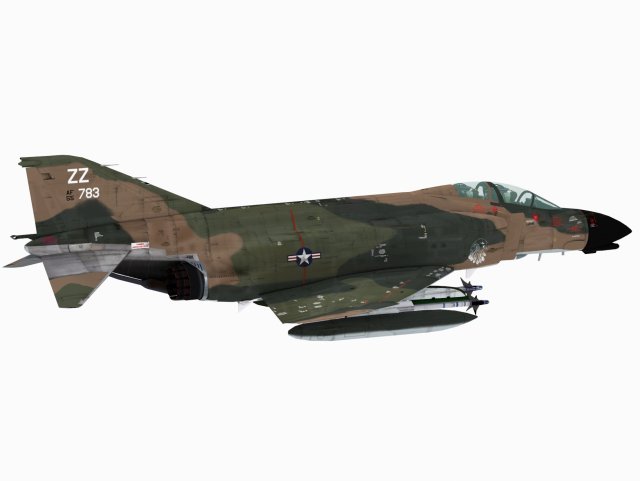
McDonnell Douglas F-4 D Phantom USAF scheme 3D Model
The F-4D joined combat forces in Southeast Asia in May 1967. The F-4D relegated most of the F-4Cs to the ground attack role while the F-4Ds were tasked with air to air interception duties. In addition to the AIM-7 Sparrow and AIM-9 Sidewinder, the F-4D was also capable of firing the Falcon missile. The Falson missile proved to be a failure, and after a brief trial period it was withdrawn from Vietnam combat service. The F-4 proved its worth in combat 05 June 1967, when a crew from the 555th Tactical Fighter Squadron downed a MiG-17 with an AIM-7 Sparrow missile. F-4Ds were the first aircraft to use laser guided munitions carrying GBU-1O/B Mk 84 Laser guided bombs in May 1968. USAF F-4s also flew reconnaissance and “Wild Weasel” anti-aircraft missile suppression missions
-
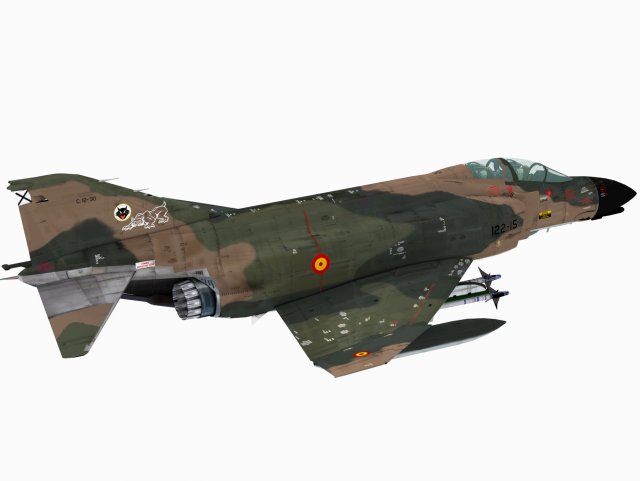
McDonnell Douglas F-4 C Phantom Ala 12 scheme Spain 3D Model
The Phantom II was first developed for U.S. Navy fleet defense. The U. S. Air Force’s first version, the F-4C, made its first flight in May 1963, and production deliveries began soon after. In 1965, the U. S. Air Force sent its first F-4Cs to Southwest Asia where they flew air-to-air combat missions against North Vietnamese fighters. The aircraft carried out secondary mission of attacking key ground targets.In its air-to-ground role, the F-4C could carry twice the payload of a World War II B-17. The aircraft carries two external fuel tanks on the outboard pylons and one ALQ-87 electronic countermeasures (ECM) pod on the right inboard pylon. here comes with spanish scheme from Ala 12 in Torrejon (Madrid)
-
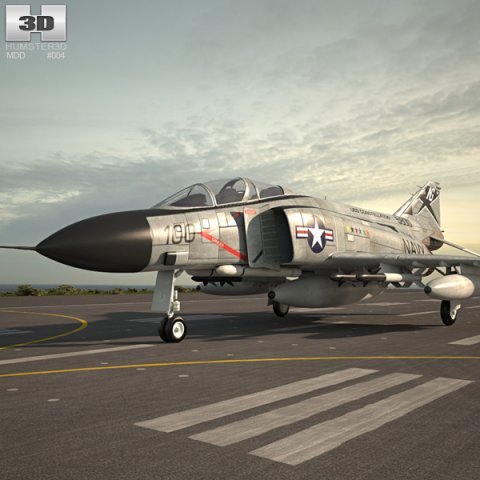
McDonnell Douglas F-4 Phantom II 3D Model
The 3D model was created on real base. It’s created accurately, in real units of measurement, qualitatively and maximally close to the original.Model formats:- *.max (3ds Max 2008 scanline)- *.max (3ds Max 2008 vray)- *.fbx (Multi Format)- *.obj (Multi Format)- *.3ds (Multi Format)- *.mb (Maya 8.5)- *.lwo (Lightwave 6)- *.c4d (Cinema 4D 11)* renders Are made in 3ds Max 2008 using vray 1.5 (studio environment is not included in the set)If you need any other formats we are more than happy to make them for you.The model is provided combined, all main parts are presented as separate parts therefore materials of objects are easy to be modified or removed and standard parts are easy to be replaced. If you experience difficulties with separating standard parts we are more than happy to give you qualified assistance.We greatly appreciate you choosing our 3D models and hope they will be of use.We look forward to continuously dealing with you.Sincerely Yours,Hum3D Team
-
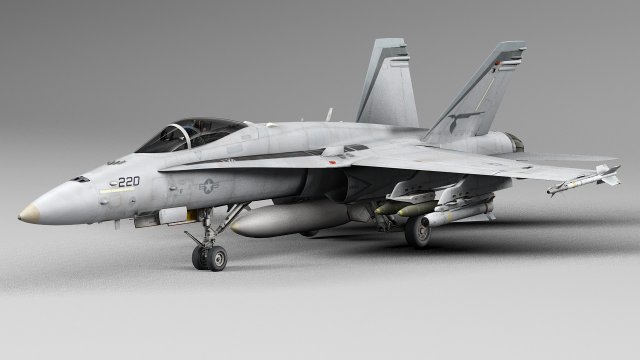
McDonnell Douglas FA-18 Hornet 3D Model
This high quality 3d model for 3ds Max, Cinema 4D and Element 3D – McDonnell Douglas F/A-18 Hornet.The model is provided combined, all main parts are presented as separate parts therefore materials of objects are easy to be modified or removed and standard parts are easy to be replaced. Item included file scene with all light setups and materials. Just click the render button and youll get image like preview images .File formats:-.3ds(multi format)-.fbx (multi format)-.obj (multi format)-.c4d(Cinema 4D R15 and above)-.max(3ds Max 2014 and above)-.e3d(plugin Element 3D v2.2 from Videocopilot)Features:- 3d model is completely ready for detailed and beautiful rendering and animation.- High-poly- element 3d v2.2- The model have clean topology- All objects are separated and named- Suitable for close-up rendering- You can easily change or aply new materials, color and other.All parts of this model have been modelled separately to achieve as much realism as possible.It can be used as a production model without any requirement of additional modeling and texturing.Sincerely Yours,Cactus 3D Team
-
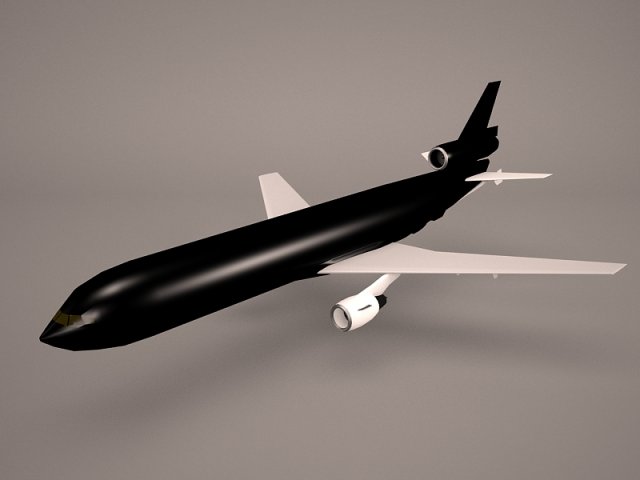
KDC10 RNL 3D Model
Royal Netherlands Forcere fueler refuel refueling Extender McDonnell Douglas KDC10 KDC KC KD 10 KC10 KD10 airplane aircraft air plane
-
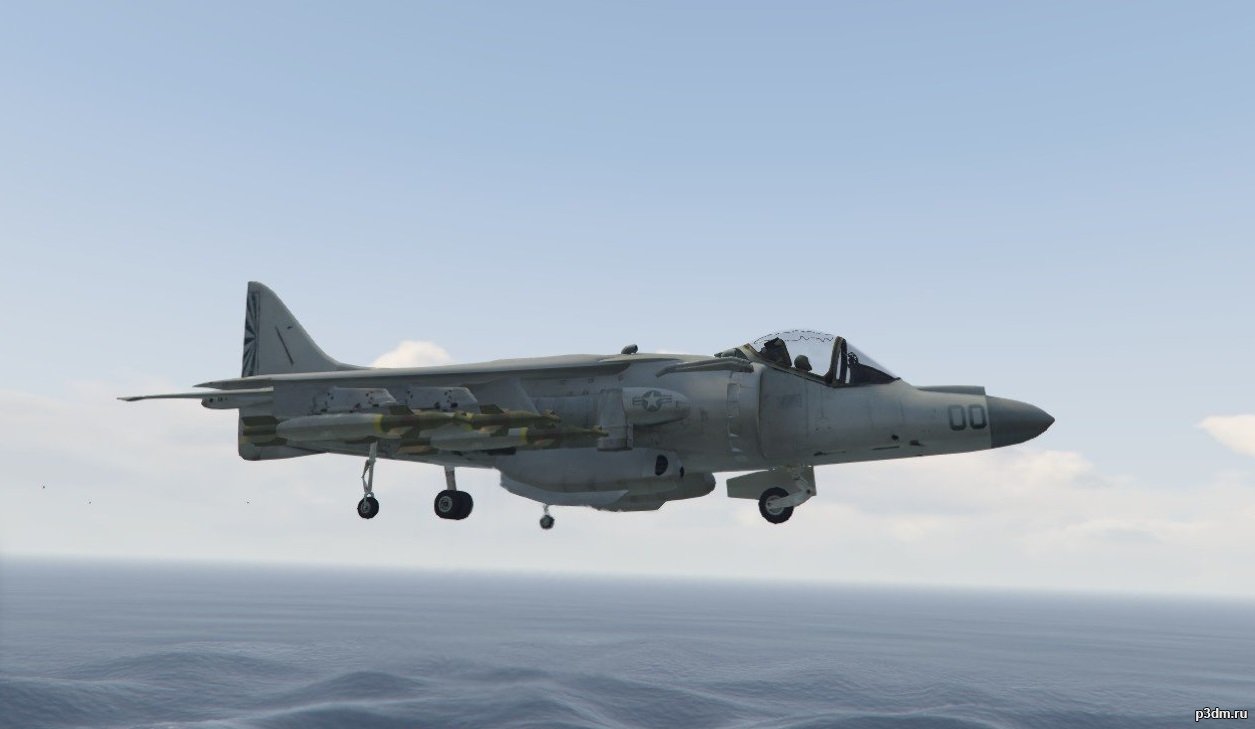
McDonnell Douglas AV-8B Harrier II 3D Model
Модель американского палубного штурмовика вертикального взлета-посадки. Используется в основном КМП и ВМС США в составах ударных авианосных групп, а так же ВВС некоторых стран.Модель имеет хорошую детализацию и кабину, подходящую для вида от первого лица.
-
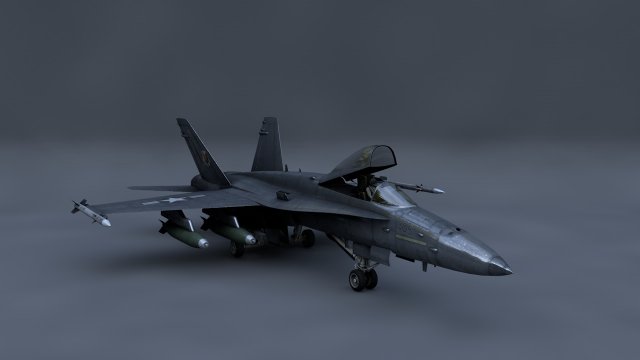
McDonnell Douglas FA-18 3D Model
Used 4 k textures.The McDonnell Douglas F/A-18 Hornet is a twin-engine supersonic, all-weather carrier-capable multirole combat jet, designed as both a fighter and attack aircraft (hence the F/A designation). Designed by McDonnell Douglas (now Boeing) and Northrop, the F/A-18 was derived from the latter’s YF-17 in the 1970s for use by the United States Navy and Marine Corps. The Hornet is also used by the air forces of several other nations and, since 1986, by the U.S. Navy’s Flight Demonstration Squadron, the Blue Angels.The F/A-18 has a top speed of Mach 1.8 (1,034 knots, 1,190 mph or 1,915 km/h at 40,000 ft or 12,200 m). It can carry a wide variety of bombs and missiles, including air-to-air and air-to-ground, supplemented by the 20-mm M61 Vulcan cannon. It is powered by two General Electric F404 turbofan engines, which give the aircraft a high thrust-to-weight ratio. The F/A-18 has excellent aerodynamic characteristics, primarily attributed to its leading-edge extensions. The fighter’s primary missions are fighter escort, fleet air defense, Suppression of Enemy Air Defenses (SEAD), air interdiction, close air support, and aerial reconnaissance. Its versatility and reliability have proven it to be a valuable carrier asset, though it has been criticized for its lack of range and payload compared to its earlier contemporaries, such as the Grumman F-14 Tomcat in the fighter and strike fighter role, and the Grumman A-6 Intruder and LTV A-7 Corsair II in the attack role.The Hornet first saw combat action during the 1986 United States bombing of Libya and subsequently participated in the 1991 Gulf War and 2003 Iraq War. The F/A-18 Hornet provided the baseline design for the Boeing F/A-18E/F Super Hornet, its larger, evolutionary redesign.
-
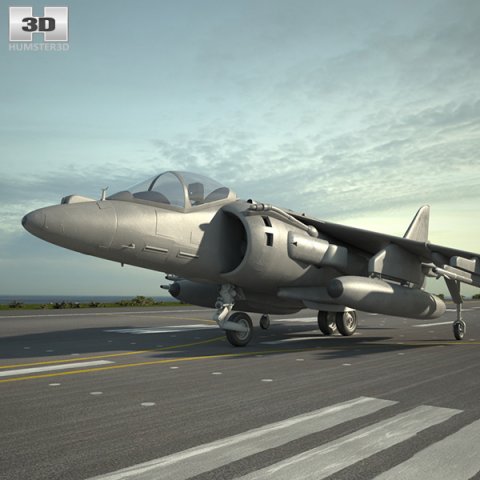
McDonnell Douglas AV-8B Harrier II 3D Model
The 3D model was created on real base. It’s created accurately, in real units of measurement, qualitatively and maximally close to the original.Model formats:- *.max (3ds Max 2008 scanline)- *.max (3ds Max 2008 vray)- *.fbx (Multi Format)- *.obj (Multi Format)- *.3ds (Multi Format)- *.mb (Maya 8.5)- *.lwo (Lightwave 6)- *.c4d (Cinema 4D 11)* renders Are made in 3ds Max 2008 using vray 1.5 (studio environment is not included in the set)If you need any other formats we are more than happy to make them for you.The model is provided combined, all main parts are presented as separate parts therefore materials of objects are easy to be modified or removed and standard parts are easy to be replaced. If you experience difficulties with separating standard parts we are more than happy to give you qualified assistance.We greatly appreciate you choosing our 3D models and hope they will be of use.We look forward to continuously dealing with you.Sincerely Yours,Hum3D Team
-
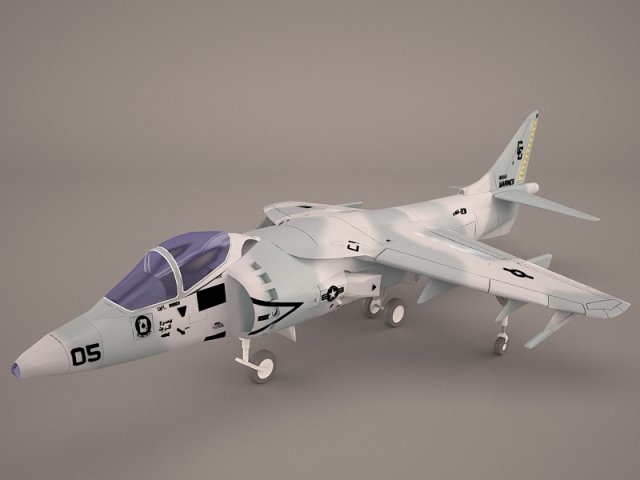
McDonnell Douglas AV-8B Harrier II 3D Model
McDonnell Douglas AV 8B Harrier II av8b boeing ground attack jet support reconnaissance recon USMC marine corps navy vray plane transportation airplane aircraft military
-
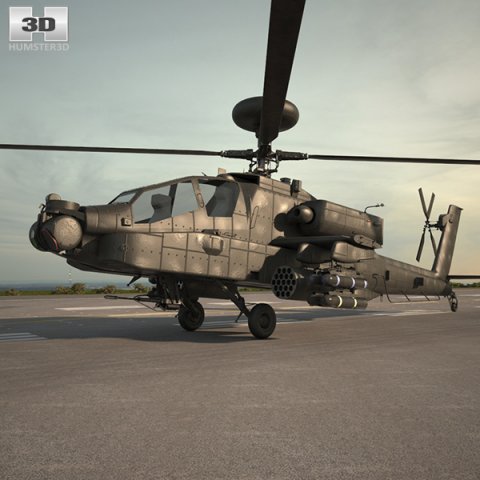
Boeing AH-64 D 3D Model
The 3D model was created on real base. It’s created accurately, in real units of measurement, qualitatively and maximally close to the original.
Model formats:
– *.max (3ds Max 2008 scanline)
– *.max (3ds Max 2008 vray)
– *.fbx (Multi Format)
– *.obj (Multi Format)
– *.3ds (Multi Format)
– *.mb (Maya 8.5)
– *.lwo (Lightwave 6)
– *.c4d (Cinema 4D 11)
* renders Are made in 3ds Max 2008 using vray 1.5 (studio environment is not included in the set)
If you need any other formats we are more than happy to make them for you.
The model is provided combined, all main parts are presented as separate parts therefore materials of objects are easy to be modified or removed and standard parts are easy to be replaced. If you experience difficulties with separating standard parts we are more than happy to give you qualified assistance.
We greatly appreciate you choosing our 3D models and hope they will be of use.
We look forward to continuously dealing with you.
Sincerely Yours,
Hum3D Team