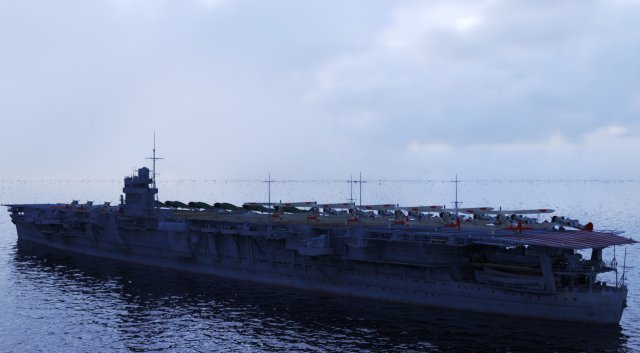
Hiryu (“Flying Dragon”) was an aircraft carrier built for the Imperial Japanese Navy (IJN) during the 1930s. The only ship of her class, she was built to a modified Soryu design.[Note 1] Her aircraft supported the Japanese invasion of French Indochina in mid-1940. During the first month of the Pacific War, she took part in the attack on Pearl Harbor and the Battle of Wake Island. The ship supported the conquest of the Dutch East Indies in January 1942. The following month, her aircraft bombed Darwin, Australia, and continued to assist in the Dutch East Indies campaign. In April, Hiryu’s aircraft helped sink two British heavy cruisers and several merchant ships during the Indian Ocean raid.After a brief refit, Hiryu and three other fleet carriers of the First Air Fleet (Kido Butai) participated in the Battle of Midway in June 1942. After bombarding American forces on the atoll, the carriers were attacked by aircraft from Midway and the carriers USS Enterprise, Hornet, and Yorktown. Dive bombers from Yorktown and Enterprise crippled Hiryu and set her afire. She was scuttled the following day after it became clear that she could not be salvaged. The loss of Hiryu and three other IJN carriers at Midway was a crucial strategic defeat for Japan and contributed significantly to the Allies’ ultimate victory in the Pacific.Textures from 256×256 to 4096x4096Diffuse, Opacity.
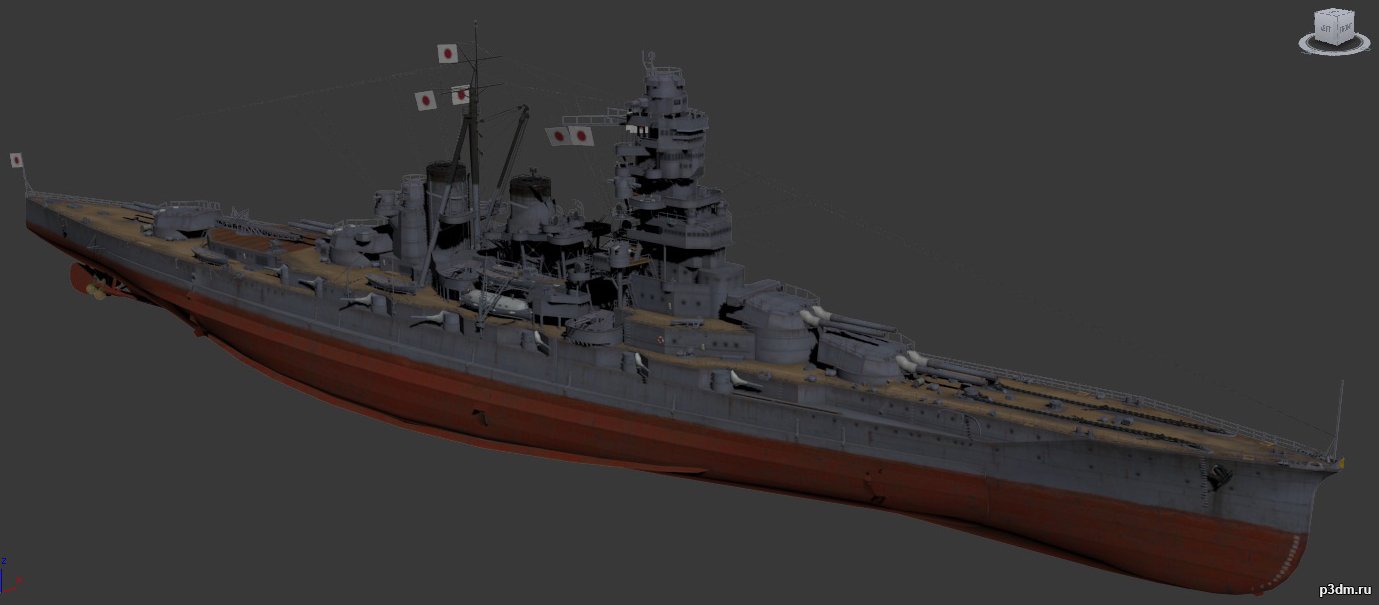
Tag: Kongo
-
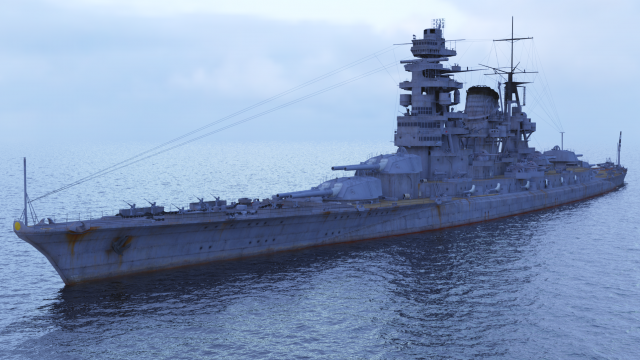
Amagi-class battlecruiser 3D Model
The Amagi class was a series of four battlecruisers planned for the Imperial Japanese Navy as part of the Eight-eight fleet. The ships were to be named Amagi, Akagi, Atago, and Takao (initially named Ashitaka), after the mountains Amagi, Akagi, Atago, and Takao.[A 1] The Amagi design was essentially a lengthened version of the Tosa-class battleship, but with a thinner armored belt and deck and a modified secondary battery arrangement.Limitations imposed by the 1922 Washington Naval Treaty prevented the class from being completed as designed. However, the treaty had a limited allowance for hulls already under construction to be converted into aircraft carriers. Amagi and Akagi were both intended for conversion, but an earthquake damaged the hull of Amagi so extensively that the ship was scrapped. Akagi was reconstructed as an aircraft carrier and served with distinction as part of the Kido Butai during the Second World War, participating in the Japanese attack on Pearl Harbor before being sunk at the Battle of Midway.Textures from 256×256 to 4096x4096Diffuse, Opacity.
-
Amagi-class battlecruiser 3D Model
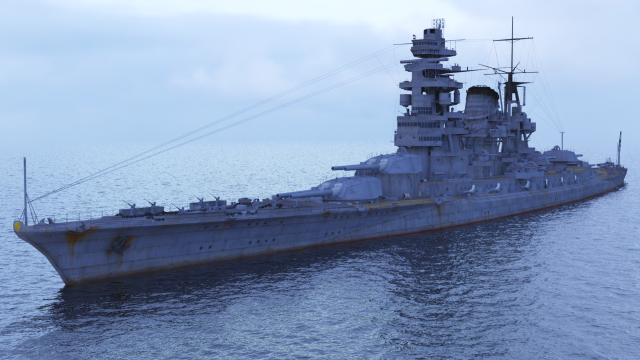
The Amagi class was a series of four battlecruisers planned for the Imperial Japanese Navy as part of the Eight-eight fleet. The ships were to be named Amagi, Akagi, Atago, and Takao (initially named Ashitaka), after the mountains Amagi, Akagi, Atago, and Takao.[A 1] The Amagi design was essentially a lengthened version of the Tosa-class battleship, but with a thinner armored belt and deck and a modified secondary battery arrangement.Limitations imposed by the 1922 Washington Naval Treaty prevented the class from being completed as designed. However, the treaty had a limited allowance for hulls already under construction to be converted into aircraft carriers. Amagi and Akagi were both intended for conversion, but an earthquake damaged the hull of Amagi so extensively that the ship was scrapped. Akagi was reconstructed as an aircraft carrier and served with distinction as part of the Kido Butai during the Second World War, participating in the Japanese attack on Pearl Harbor before being sunk at the Battle of Midway.Textures from 256×256 to 4096×4096 DDSDiffuse, Opacity.