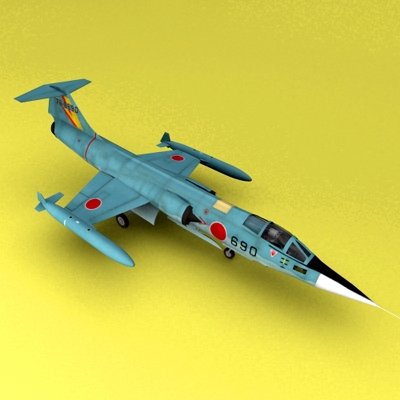
Because of its physical appearance and performance, the F-104 has often been called the ‘missile with a man in it.’ The design was a product of the Korean War, and was unique in several respects. The encounters with the MiG-15 in Korea caused a strong outcry among Air Force fighter pilots for a cheap, lightweight, maneuverable, high-performance fighter to confront future Soviet fighters. The result was the F-104, a fighter that overemphasized rate of climb and brute speed. Intended as a point defense interceptor, range was sacrificed for rate of climb. Range, however, could be extended using external tanks and in-flight refueling. It used an exceptionally small wing span of only 21 feet, and provided low speed lift through air bled from the engine and vented over the wing. Designed as a supersonic superiority fighter, the F-104 was produced in two major versions. Armed with a six-barrel M-61 20mm Vulcan cannon it served as a tactical fighter and, equipped additionally with heat-seeking Sidewinder missiles, as a day-night interceptor. The USAF procured about 300 Starfighters in one- and two-seat versions. The texture is for JASDF.
Tag: isaf
-
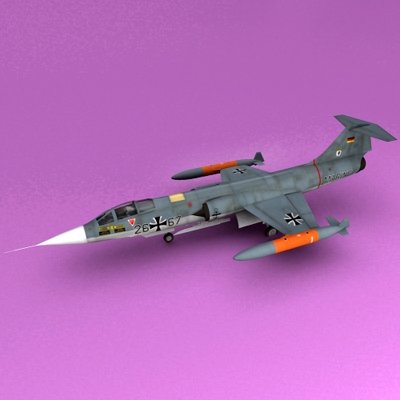
F-104 3D Model
Because of its physical appearance and performance, the F-104 has often been called the “missile with a man in it.” The design was a product of the Korean War, and was unique in several respects. The encounters with the MiG-15 in Korea caused a strong outcry among Air Force fighter pilots for a cheap, lightweight, maneuverable, high-performance fighter to confront future Soviet fighters. The result was the F-104, a fighter that overemphasized rate of climb and brute speed. Intended as a point defense interceptor, range was sacrificed for rate of climb. Range, however, could be extended using external tanks and in-flight refueling. It used an exceptionally small wing span of only 21 feet, and provided low speed lift through air bled from the engine and vented over the wing. Designed as a supersonic superiority fighter, the F-104 was produced in two major versions. Armed with a six-barrel M-61 20mm Vulcan cannon it served as a tactical fighter and, equipped additionally with heat-seeking Sidewinder missiles, as a day-night interceptor. The USAF procured about 300 Starfighters in one- and two-seat versions. The texture is for Germany Marine.
-
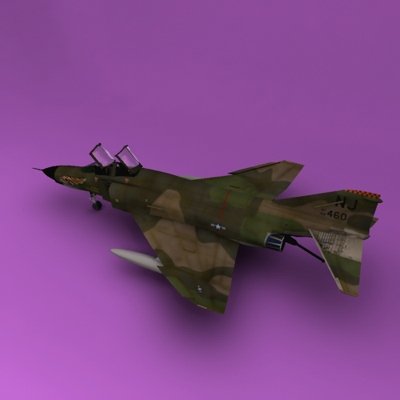
F-4 3D Model
The F-4 Phantom II was a twin-engine, all-weather, fighter-bomber. The aircraft could perform three tactical air roles — air superiority, interdiction and close air support — as it did in southeast Asia. First flown in May 1958, the Phantom II originally was developed for U.S. Navy fleet defense and entered service in 1961. The USAF evaluated it for close air support, interdiction, and counter-air operations and, in 1962, approved a USAF version. The USAF’s Phantom II, designated F-4C, made its first flight on May 27, 1963. Production deliveries began in November 1963. In its air-to-ground role the F-4 could carry twice the normal bomb load of a WW II B-17. USAF F-4s also flew reconnaissance and “Wild Weasel” anti-aircraft missile suppression missions. Phantom II production ended in 1979 after over 5,000 had been built–more than 2,600 for the USAF, about 1,200 for the Navy and Marine Corps, and the rest for friendly foreign nations, including to Israel, Iran, Greece, Spain, Turkey, South Korea, West Germany, Australia, Japan, and Great Britain. Used extensively in the Vietnam War, later versions of the aircraft were still active in the U. S. Air Force inventory well into the 1990s. F-4s are no longer in the USAF inventory but are still flown by foreign nations. This texture is for U.S Air Force.
-
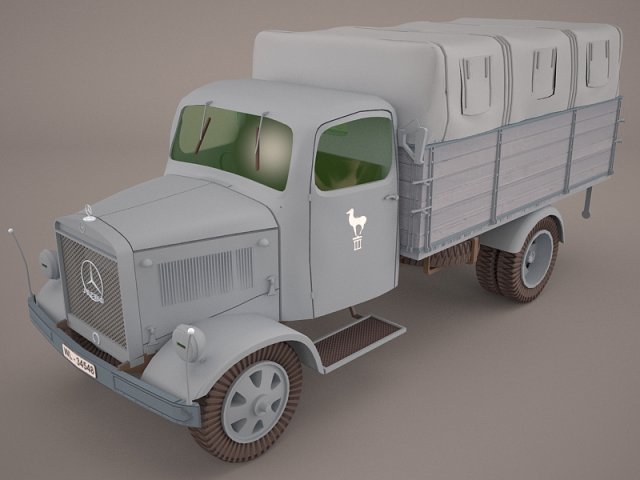
Mercedes Benz Unimog U1300 German Army ISAF 3D Model
Mercedes Benz Unimog U1300 Four wheel drive medium truck Isaf German Heer Military Vehicle Off-Road 4×4 Army Transport Bundeswehr
-
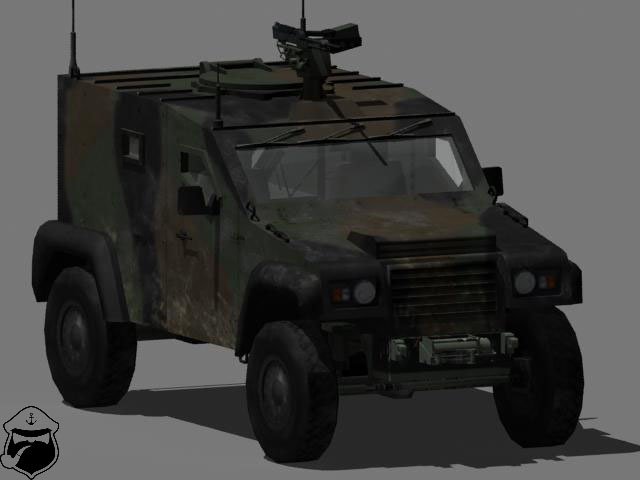
Panhard PVP 3D Model
The Petit Véhicule Protégé (“Small Protected vehicle”) is a light, general-purpose armoured 4-wheel drive vehicle used by the French Army, made by Panhard. It is also designated as Auverland A4 AVL (Armoured Vehicle Light). Built by Auverland, it is the successor to the Peugeot P4. It is intended mostly as personnel carrier, weapon carrier, and for reconnaissance, detection and communications purposes.The PVP is modular, allowing extra seats to be added for more personnel, or to be used as a light truck. The armour, made of steel and aluminium, offers level 2 protection (STANAG 4569) for the crew and the engine. The floor is protected against antipersonnel mines (type DM 31).