Summary
This is a hyperbolic curve rotated around its transverse axis to make a solid.
Both horizontal and vertical shapes are in the OpenSCAD script.
Horizontal gives the desired results with rotate_extrude, but the vertical axis shape is fun and possibly useful.
This solid was designed to be part of a multi-reflector cassegrain style antenna design for 122GHz amateur radio inspired by Paul Wade W1GHZ’s writeup. Link below!
Find out more about the 3D printable 122GHz antenna system at:https://github.com/Abraxas3d/122GHz
And here is Paul Wade’s writeup:http://www.w1ghz.org/antbook/conf/Multiple_reflector_antennas.pdf
How I Designed This
OpenSCAD Script
//Hyperbolic Solid in OpenSCAD
//by Michelle Thompson @abraxas3d
//A hyperbola is the set of all points where the difference
//in the distance from intstwo fixed po is a constant.
//What we are after here is the positive half of a hyperbola.
//We then rotate it around its transverse axis in order
//to make a hyperbolic surface.
//This hyperbolic surface is then 3D printed in order to
//provide a prototype subreflector for a microwave cassegrain
//antenna system for radio experimentation.
//equation for a hyperbola is (x^2)/(a^2) – (y^2)/(b^2) = 1
// x = a sec(angle)
// y = b tan(angle)
// angle varies from 0 to pi/2
//a and b are the dimensions of the box that defines the
//asymptotes of the hyperbolic curve.
a = 40; //affects height of the vertex above origin and how tall shape ends up.
b = 40; //radius
//resolution variable in OpenSCAD. Higher numbers mean smoother surface.
$fn = 200;
max_angle = 45; //affects how tall the shape ends up.
angle_resolution = 0.5;
//granularity should match the length of the polygon vector
//before we add the two finishing points that complete a closed curve.
granularity = max_angle/angle_resolution;
//Depending on the behavior desired, one might want either
//a vertical or a horizontal hyperbolic curve.
//choose which one here.
//set horizontal to true for horizontal (creates the right shape when rotated).
//set horizontal to false for vertical (creates an interesting shape when rotated).
horizontal = true;
//For horizontal case:
//we are defining functions that make a vector of points.
//each point is a vector in and of itself in the form [x,y]
//the vector of points follows a horizontal hyperbolic curve.
//the independent variable is the angle from 0 to max_angle.
//we use concat() to build the vector of points as long as
//we do not exceed the max_angle. we increment by angle_resolution
//and then calculate a new set of points.
//secant is the reciprocal of cosine
function horiz_hyper(angle) = angle < max_angle ? concat([[btan(angle), a(1/(cos(angle)))]], horiz_hyper(angle + angle_resolution)) : [];
//For vertical case:
//we are defining functions that make a vector of points.
//each point is a vector in and of itself in the form [x,y]
//the vector of points follows a vertical hyperbolic curve.
//the independent variable is the angle from 0 to max_angle.
//we use concat() to build the vector of points as long as
//we do not exceed the max_angle. we increment by angle_resolution
//and then calculate a new set of points.
//secant is the reciprocal of cosine
function vert_hyper(angle) = angle < max_angle ? concat([[ a(1/(cos(angle))) , btan(angle)]], vert_hyper(angle + angle_resolution)) : [];
if (horizontal == true) {
//we have a hyperbolic curve, but it needs to be closed so
//that we can turn it into a polygon and then rotate to get a solid.
//uncomment this block for checks
/*
//check the length of the vector
echo(len(horiz_hyper(0)));
//check the last entry
echo(horiz_hyper(0)[granularity – 1]);
//check the y value from the last set of points.
echo(horiz_hyper(0)[granularity – 1][1]);
//check entire list of points.
echo(horiz_hyper(0));
*/
//get the y value from the last set of points.
replace_horiz = horiz_hyper(0)[granularity – 1][1];
//add two points to the curve to close it, using concat().
//first, stay at current y value, but set x to zero so that
//we come across to the y axis to make the top of the polygon.
//then, drop straight down to where we started.
full_set_horiz = concat(horiz_hyper(0), [[0, replace_horiz]], [[0,a]]);
//show the polygon we created.
/
translate([0, 0, 0]) polygon(full_set_horiz);/
//use rotate_extrude to rotate the 2d polygon and make it a 3d shape.
//translate moves it to origin. Set -a to 0 if you want it to be at
//its calculated position!
translate([0, 0, -a]) rotate_extrude(angle = 360, convexity = 10) polygon(full_set_horiz);
} else {
//we have a hyperbolic curve, but it needs to be closed so
//that we can turn it into a polygon and then rotate to get a solid.
//uncomment this block for checks
/*
//check the length of the vector
echo(len(vert_hyper(0)));
//check the last entry
echo(vert_hyper(0)[granularity – 1]);
//check the x value from the last set of points.
echo(vert_hyper(0)[granularity – 1][0]);
//check entire list of points.
echo(vert_hyper(0));
*/
//get the x value from the last set of points.
replace_vert = vert_hyper(0)[granularity – 1][0];
//add two points to the curve to close it, using concat().
//first, stay at current x value, but set y to zero so that
//we come across to the x axis to make the top of the polygon.
//then, drop straight down to where we started.
full_set_vert = concat(vert_hyper(0), [[replace_vert, 0]], [[a,0]]);
//show the polygon we created.
/
translate([0, 0, 0]) polygon(full_set_vert);/
//use rotate_extrude to rotate the 2d polygon and make it a 3d shape.
rotate_extrude(angle = 360, convexity = 10) translate([0, 0, 0]) polygon(full_set_vert);
}
Tag: hyperbolic
-
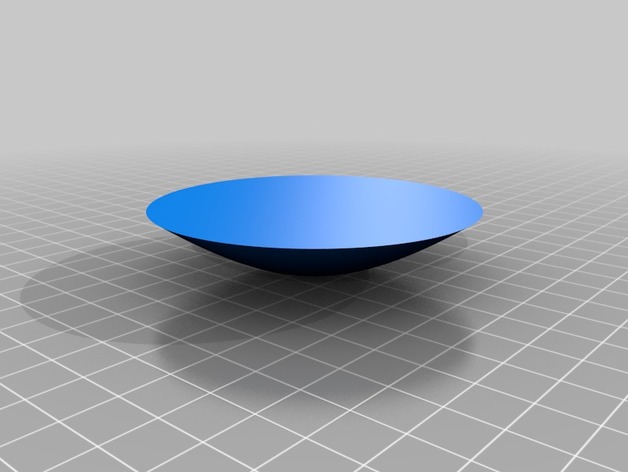
hyperbolic solid 3D Print Model