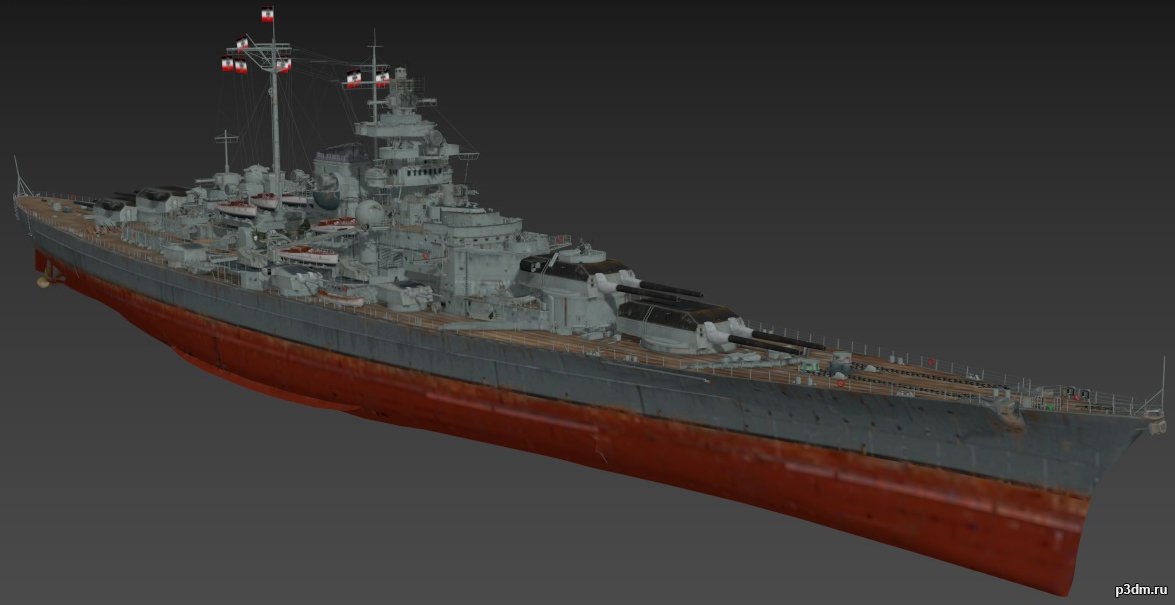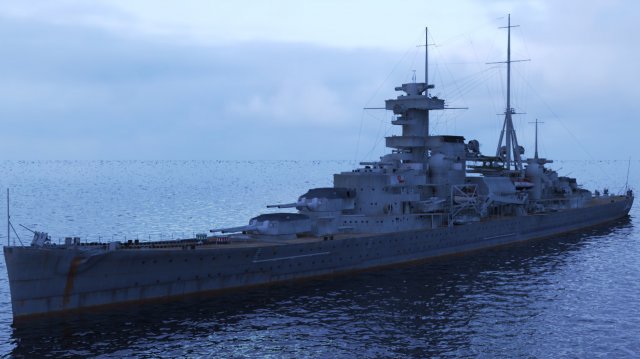
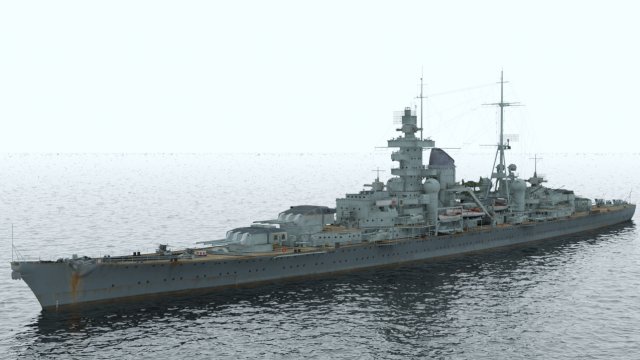
The Admiral Hipper class was a group of five heavy cruisers built by Nazi Germany’s Kriegsmarine beginning in the mid-1930s. The class comprised Admiral Hipper, the lead ship, Blucher, Prinz Eugen, Seydlitz, and Lutzow. Only the first three ships of the class saw action during World War II. Work on Seydlitz stopped when she was approximately 95 percent complete; it was decided to convert her into an aircraft carrier, but this was not completed either. Lutzow was sold incomplete to the Soviet Union in 1940.Textures: from 512×512 to 4096x409Diffuse, Opasity.
Tag: 1942
-
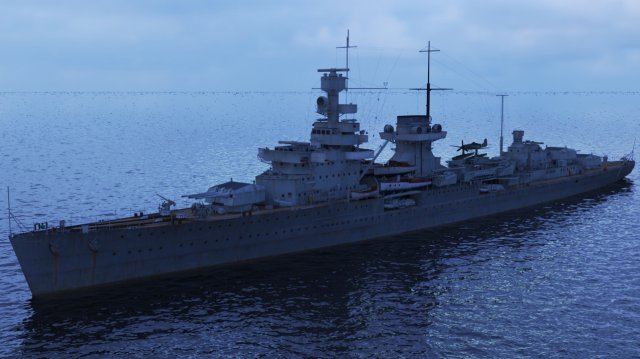
German cruiser Nurnberg with Ta-152 3D Model
Nurnberg was a German light cruiser of the Leipzig class built for the Kriegsmarine. She was named after the city of Nuremberg and had one sister ship, Leipzig. Nurnberg was laid down in 1934, launched in December of that year, and completed in November 1935. She was armed with a main battery of nine 15 cm (5.9 in) guns in three triple turrets and could steam at a speed of 32 knots (59 km/h; 37 mph). Nurnberg was the longest-serving major warship of the Kriegsmarine, and the only one to see active service after the end of World War II, though not in a German navy.Textures: from 512×512 to 4096x409Diffuse, Opasity.
-
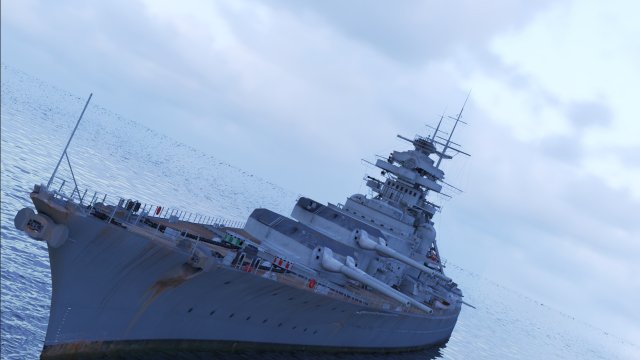
German battleship Bismarck 3D Model
Bismarck was the first of two Bismarck-class battleships built for Nazi Germany’s Kriegsmarine. Named after Chancellor Otto von Bismarck, the ship was laid down at the Blohm & Voss shipyard in Hamburg in July 1936 and launched in February 1939. Work was completed in August 1940, when she was commissioned into the German fleet. Bismarck and her sister ship Tirpitz were the largest battleships ever built by Germany, and two of the largest built by any European power.Textures: from 512×512 to 4096x409Diffuse, Specular, Normal, Opasity.
-
SMS Hindenburg with Ta-152 Ar-196 3D Model
SMS Hindenburg was a battlecruiser of the German Kaiserliche Marine (Imperial Navy), the third ship of the Derfflinger class, built to a slightly modified design. She carried the same battery of eight 30.5 cm (12.0 in) guns, but in improved turrets that allowed them to fire further. The ship was also slightly larger and faster than her two sister ships. She was named in honor of Field Marshal Paul von Hindenburg, the victor of the Battle of Tannenberg and the Battle of the Masurian Lakes, as well as Supreme Commander of the German armies from 1916. The ship was the last capital ship of any type built for the German navy during World War I.Hindenburg was commissioned late in the war and as a result had a brief service career. The ship took part in a handful of short fleet operations as the flagship of the I Scouting Group in 1917–18, though saw no major action. The proposed final sortie of the fleet in the last weeks of the war came to nothing when the crews of the capital ships mutinied. Hindenburg was subsequently interned with the rest of the German battlecruisers at Scapa Flow in November 1918. Rear Admiral Ludwig von Reuter ordered the ships be scuttled on 21 June 1919. Hindenburg was the last of the ships to sink. She was raised in 1930 and broken up for scrap over the following two years.Textures: from 512×512 to 4096x409Diffuse, Opasity.
-
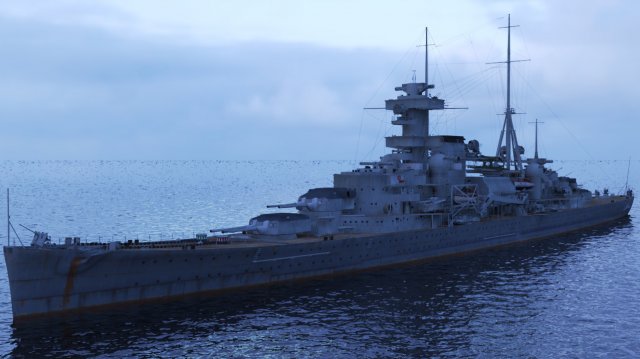
Admiral Hipper-class cruiser with Ta-152 3D Model
The Admiral Hipper class was a group of five heavy cruisers built by Nazi Germany’s Kriegsmarine beginning in the mid-1930s. The class comprised Admiral Hipper, the lead ship, Blucher, Prinz Eugen, Seydlitz, and Lutzow. Only the first three ships of the class saw action during World War II. Work on Seydlitz stopped when she was approximately 95 percent complete; it was decided to convert her into an aircraft carrier, but this was not completed either. Lutzow was sold incomplete to the Soviet Union in 1940.Textures: from 512×512 to 4096x409Diffuse, Opasity.
-
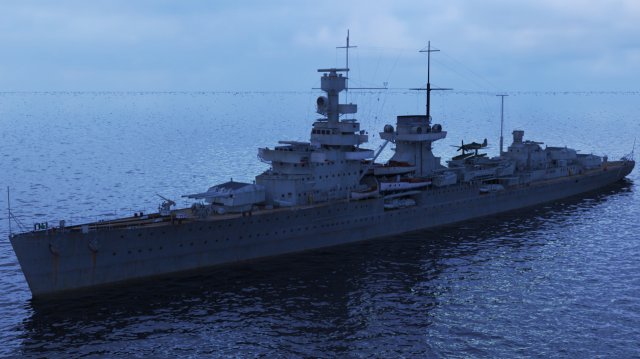
German cruiser Nurnberg with Ta-152 3D Model
Nurnberg was a German light cruiser of the Leipzig class built for the Kriegsmarine. She was named after the city of Nuremberg and had one sister ship, Leipzig. Nurnberg was laid down in 1934, launched in December of that year, and completed in November 1935. She was armed with a main battery of nine 15 cm (5.9 in) guns in three triple turrets and could steam at a speed of 32 knots (59 km/h; 37 mph). Nurnberg was the longest-serving major warship of the Kriegsmarine, and the only one to see active service after the end of World War II, though not in a German navy.Textures: from 512×512 to 4096x409Diffuse, Opasity.
-
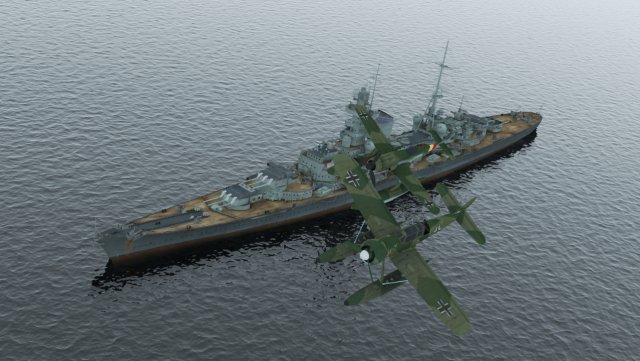
SMS Hindenburg with Ta-152 Ar-196 3D Model
SMS Hindenburg was a battlecruiser of the German Kaiserliche Marine (Imperial Navy), the third ship of the Derfflinger class, built to a slightly modified design. She carried the same battery of eight 30.5 cm (12.0 in) guns, but in improved turrets that allowed them to fire further. The ship was also slightly larger and faster than her two sister ships. She was named in honor of Field Marshal Paul von Hindenburg, the victor of the Battle of Tannenberg and the Battle of the Masurian Lakes, as well as Supreme Commander of the German armies from 1916. The ship was the last capital ship of any type built for the German navy during World War I.Hindenburg was commissioned late in the war and as a result had a brief service career. The ship took part in a handful of short fleet operations as the flagship of the I Scouting Group in 1917–18, though saw no major action. The proposed final sortie of the fleet in the last weeks of the war came to nothing when the crews of the capital ships mutinied. Hindenburg was subsequently interned with the rest of the German battlecruisers at Scapa Flow in November 1918. Rear Admiral Ludwig von Reuter ordered the ships be scuttled on 21 June 1919. Hindenburg was the last of the ships to sink. She was raised in 1930 and broken up for scrap over the following two years.Textures: from 512×512 to 4096x409Diffuse, Opasity.
-
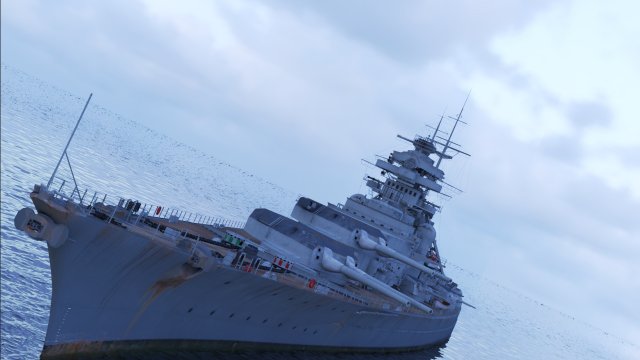
German battleship Bismarck 3D Model
Bismarck was the first of two Bismarck-class battleships built for Nazi Germany’s Kriegsmarine. Named after Chancellor Otto von Bismarck, the ship was laid down at the Blohm & Voss shipyard in Hamburg in July 1936 and launched in February 1939. Work was completed in August 1940, when she was commissioned into the German fleet. Bismarck and her sister ship Tirpitz were the largest battleships ever built by Germany, and two of the largest built by any European power.Textures: from 512×512 to 4096x409Diffuse, Specular, Normal, Opasity.
-
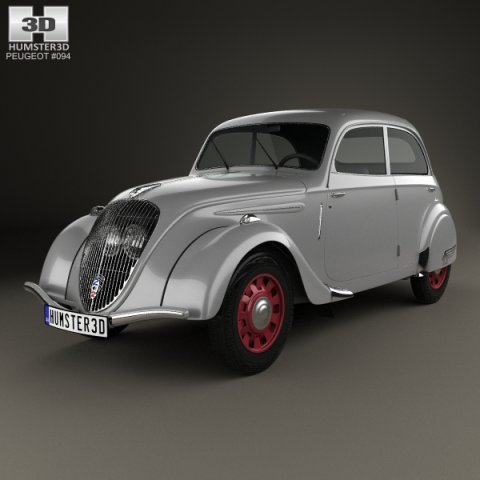
Peugeot 202 Berline 1938 3D Model
The 3D model was created on real car base. It’s created accurately, in real units of measurement, qualitatively and maximally close to the original.Model formats:- *.max (3ds Max 2008 scanline)- *.max (3ds Max 2008 vray)- *.fbx (Multi Format)- *.obj (Multi Format)- *.3ds (Multi Format)- *.mb (Maya 8.5)- *.lwo (Lightwave 6)- *.c4d (Cinema 4D 11)* tire’s texture is not included in the set.* renders Are made in 3ds Max 2008 using vray 1.5 (studio environment is not included in the set)If you need any other formats we are more than happy to make them for you.The model is provided combined, all main parts are presented as separate parts therefore materials of objects are easy to be modified or removed and standard parts are easy to be replaced. If you experience difficulties with separating standard parts we are more than happy to give you qualified assistance.We greatly appreciate you choosing our 3D models and hope they will be of use.We look forward to continuously dealing with you.Sincerely Yours,Hum3D Team
-
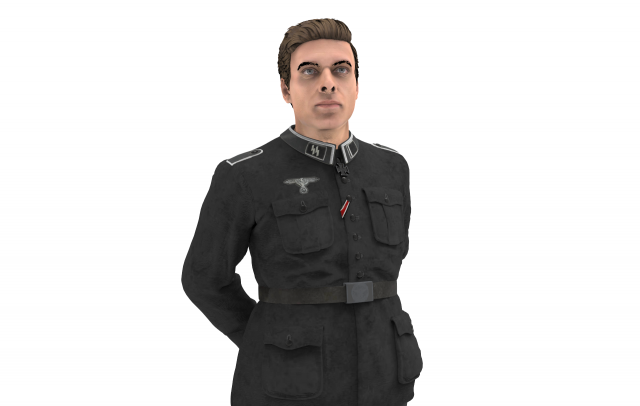
German Soldier 3D Model
German SoldierThe German Army (German: Heer, German pronunciation: [ˈheːɐ̯]) was the land forces component of the Wehrmacht, the regular German Armed Forces, from 1935 until it was demobilized and later dissolved in August 1946.[2] Though often erroneously restricted to the ground forces, the Wehrmacht also included the Kriegsmarine (Navy) and the Luftwaffe (Air Force). During World War II, a total of about 13 million soldiers served in the German Army.[3] Most army personnel were conscripted.Only 17 months after Adolf Hitler announced publicly the rearmament program, the Army reached its projected goal of 36 divisions. During the autumn of 1937, two more corps were formed. In 1938, four additional corps were formed with the inclusion of the five divisions of the Austrian Army after the Anschluss in March.[4] During the period of its expansion by Adolf Hitler, the German Army continued to develop concepts pioneered during World War I, combining ground (Heer) and air (Luftwaffe) assets into combined arms teams. Coupled with operational and tactical methods such as encirclements and the “battle of annihilation”, the German military managed quick victories in the two initial years of World War II, prompting the use of the word Blitzkrieg (literally lightning war, meaning lightning-fast war) for the techniques used.[5]The German Army entered the war with a majority of its infantry formations relying on horse-drawn transport.[verification needed] The infantry remained foot soldiers throughout the war; artillery also remained primarily horse-drawn. The motorized formations received much attention in the world press in the opening years of the war, and were cited as the main reason for the success of the German invasions of Poland (September 1939), Norway and Denmark (April 1940), Belgium, France and Netherlands (May 1940), Yugoslavia (April 1941) and Operation Barbarossa, the invasion of the Soviet Union (June 1941). However their motorized and tank formations accounted for only 20% of the Heer’s capacity at their peak strength. The army’s lack of trucks (and petroleum to run them) was a severe handicap to infantry movement especially during and after the Normandy invasion when Allied air power devastated the French rail network north of the Loire. Panzer movements also depended upon rail: driving a tank over 150 kilometers wore out its tracks.
-
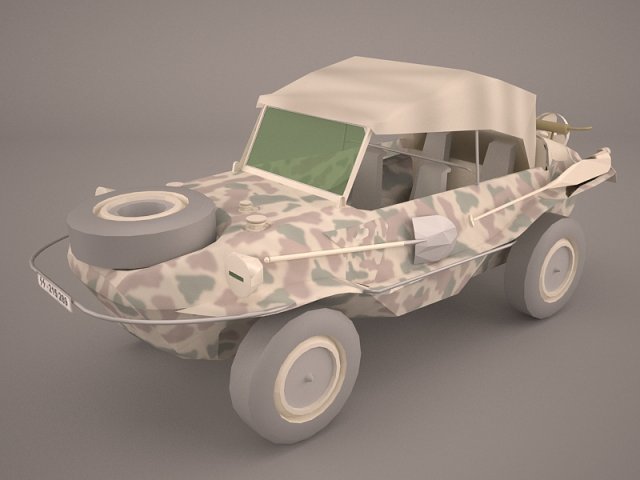
Volkswagen Kubelwagen 1945 3D Model
volkswagen kubelwagen vw military 1940 1941 1942 1943 1944 1945 suv crossover germany german car vehicle nazi
-
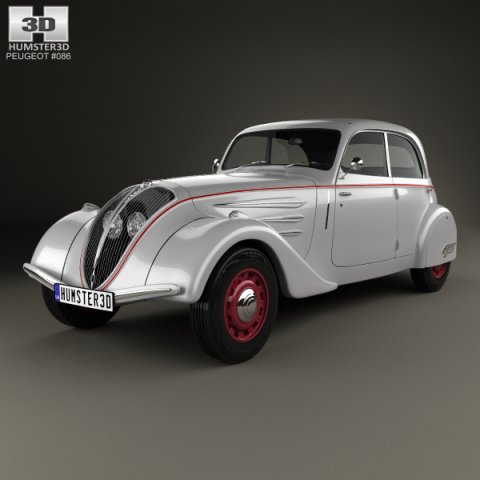
Peugeot 402 Legere 1935 3D Model
The 3D model was created on real car base. It’s created accurately, in real units of measurement, qualitatively and maximally close to the original.Model formats:- *.max (3ds Max 2008 scanline)- *.max (3ds Max 2008 vray)- *.fbx (Multi Format)- *.obj (Multi Format)- *.3ds (Multi Format)- *.mb (Maya 8.5)- *.lwo (Lightwave 6)- *.c4d (Cinema 4D 11)* tire’s texture is not included in the set.* renders Are made in 3ds Max 2008 using vray 1.5 (studio environment is not included in the set)If you need any other formats we are more than happy to make them for you.The model is provided combined, all main parts are presented as separate parts therefore materials of objects are easy to be modified or removed and standard parts are easy to be replaced. If you experience difficulties with separating standard parts we are more than happy to give you qualified assistance.We greatly appreciate you choosing our 3D models and hope they will be of use.We look forward to continuously dealing with you.Sincerely Yours,Hum3D Team
-
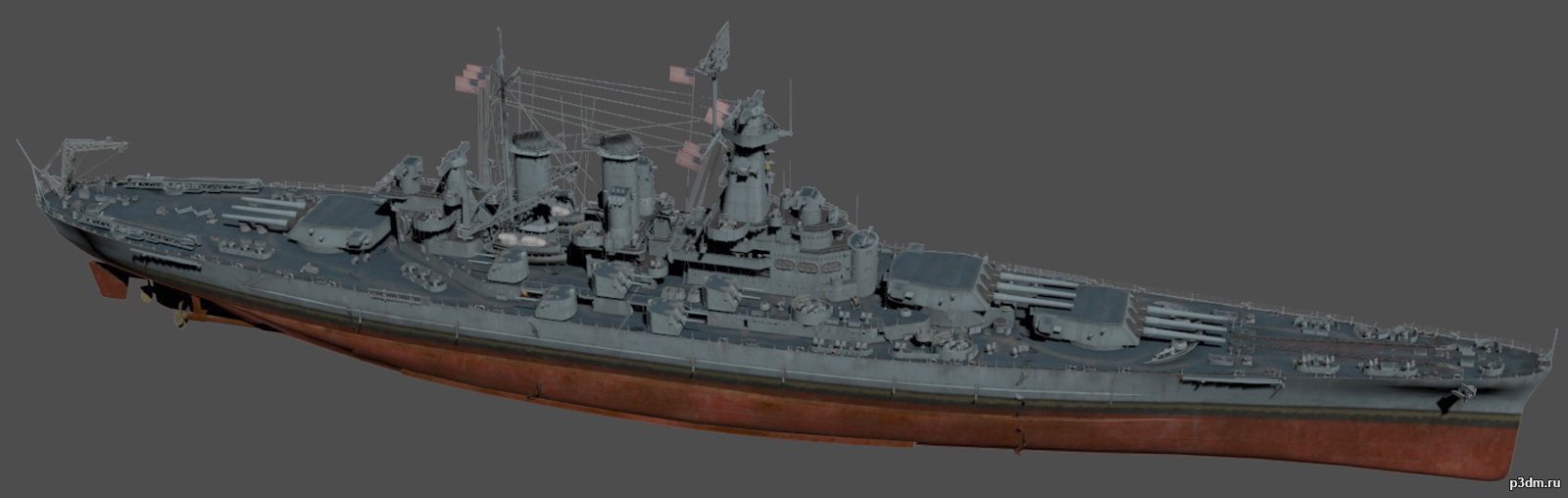
North Carolina 1942 3D Model
Линкор “North Carolina” образца 1942 года.Примечание:У модели имеются разломы.
-

Tashkent 1942 3D Model
Лидер эсминцев Черноморского флота “Ташкент”.Примечание:У модели имеются разломы.
-
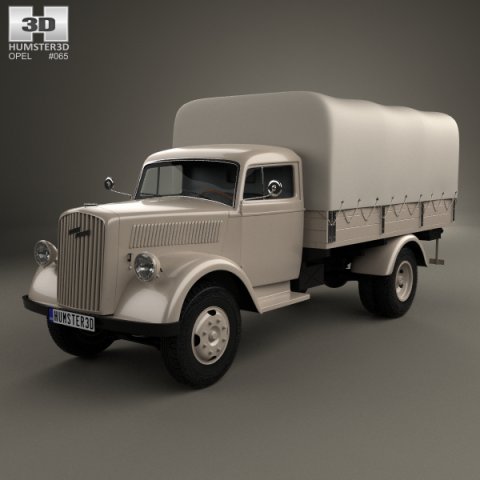
Opel Blitz Flatbed Truck 1940 3D Model
The 3D model was created on real car base. It’s created accurately, in real units of measurement, qualitatively and maximally close to the original.Model formats:- *.max (3ds Max 2008 scanline)- *.max (3ds Max 2008 vray)- *.fbx (Multi Format)- *.obj (Multi Format)- *.3ds (Multi Format)- *.mb (Maya 8.5)- *.lwo (Lightwave 6)- *.c4d (Cinema 4D 11)* tire’s texture is not included in the set.* renders Are made in 3ds Max 2008 using vray 1.5 (studio environment is not included in the set)If you need any other formats we are more than happy to make them for you.The model is provided combined, all main parts are presented as separate parts therefore materials of objects are easy to be modified or removed and standard parts are easy to be replaced. If you experience difficulties with separating standard parts we are more than happy to give you qualified assistance.We greatly appreciate you choosing our 3D models and hope they will be of use.We look forward to continuously dealing with you.Sincerely Yours,Hum3D Team
-
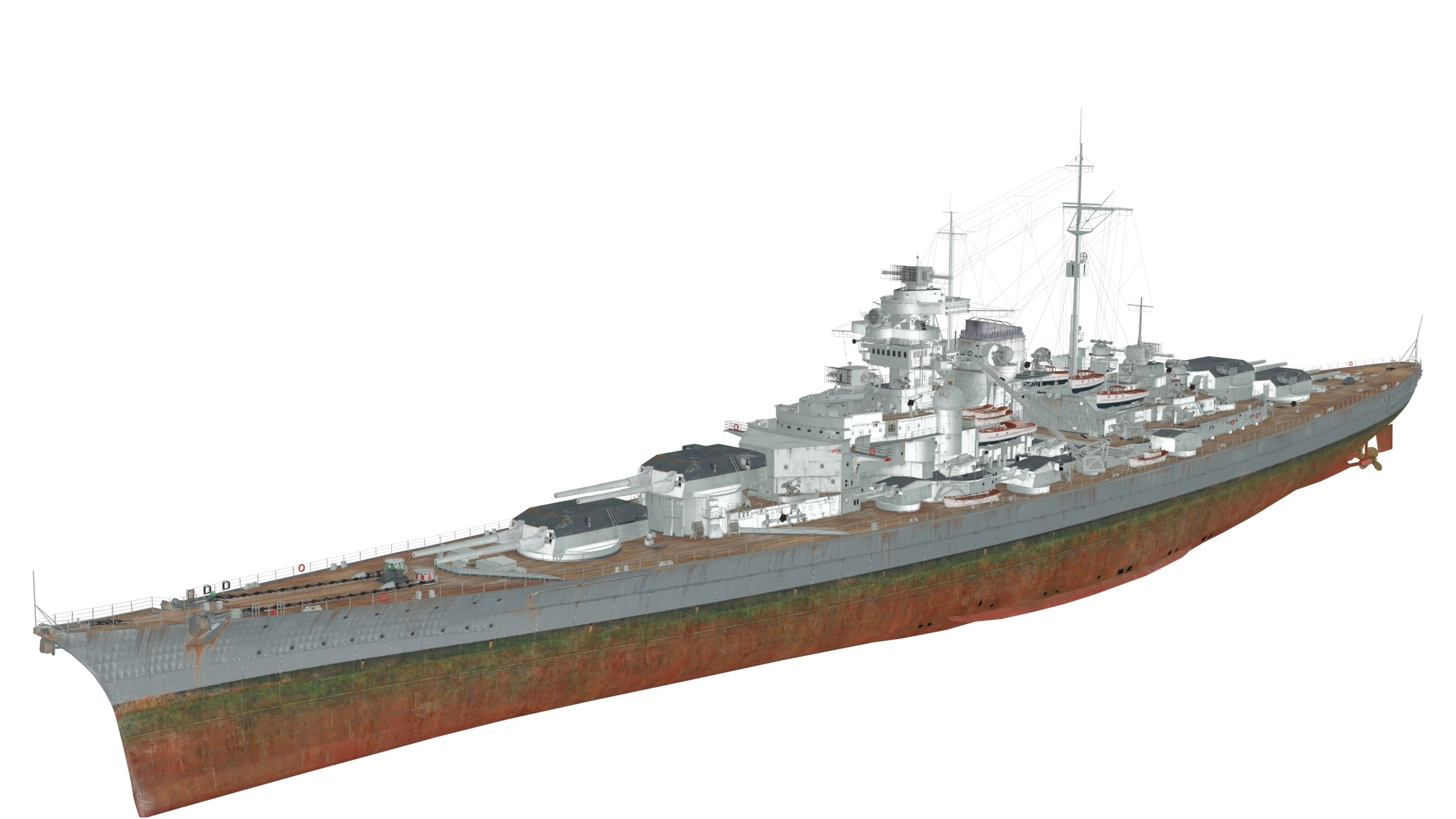
Battle ship Bismarck in detal
High detailed 3d model of the battle ship Bismarck, project 19393D model low poly for game ready and rendering.Textures: from 512×512 to 4096x409Diffuse, Specular, Normal.
-
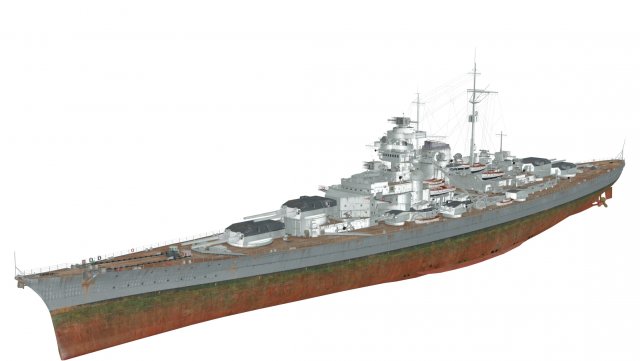
Battle ship Bismarck in detal 3D Model
High detailed 3d model of the battle ship Bismarck, project 1939
3D model low poly for game ready and rendering.
Textures: from 512×512 to 4096×409
Diffuse, Specular, Normal. -
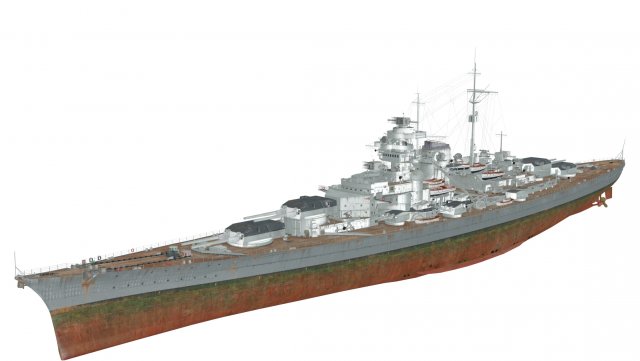
Bismarck Battleship in detal 3D Model
High detailed 3d model of the battle ship Bismarck, project 1939
3D model low poly for game ready and rendering.
Textures: from 512×512 to 4096×409
Diffuse, Specular, Normal.